From mass drone swarms in 2025 to high-complexity combined missile and UAV strikes in 2026
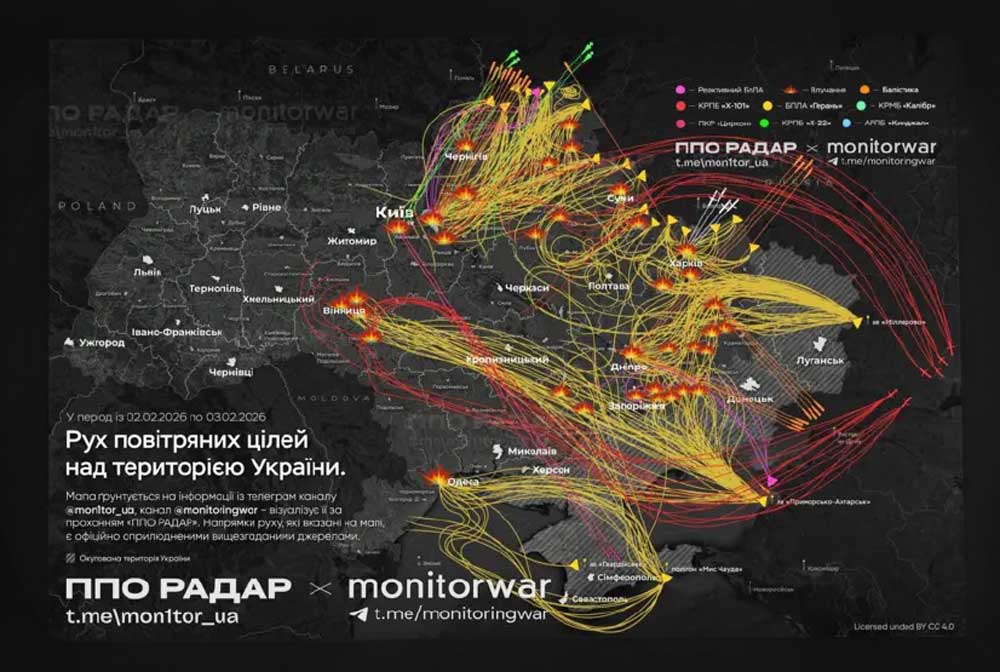
The night of February 2–3, 2026 marked a structurally significant moment in the evolution of Russia’s aerial campaign over Ukraine. It was not the largest attack in raw numbers. It was one of the most sophisticated in composition. The strike demonstrated the consolidation of a tactical evolution that had been gradually emerging since late 2025: a shift from overwhelming air defense through sheer volume of drones to compressing defensive decision cycles through integrated multi-vector complexity. Ballistic, supersonic, and hypersonic missiles were combined with large-scale UAV waves, creating a layered pressure model designed not only to penetrate air defenses, but to force simultaneous, time-critical decisions across multiple defensive layers.
As former U.S. Army Europe commander Lt. Gen. Ben Hodges has repeatedly emphasized:
“Modern warfare is no longer about mass alone. It’s about the integration of capabilities across domains.”
The February strike reflects precisely that operational logic.
Operational overview
February 3, 2026
- A total of 521 aerial assets were launched.
- 450 were intercepted.
- The overall interception rate reached 86.4%.
However, aggregate efficiency masks a more important dynamic: target type complexity.
Attack composition
| Weapons Type | Weapons Model | Warhead (kg) | Launched | Intercepted | Efficiency (%) |
|---|---|---|---|---|---|
| Strike Drone | Shahed, Gerbera, Italmas | ~50 | 450 | 412 | 91.6% |
| Cruise Missiles | Kh-101 / Iskander-K | ~400 | 28 | 20 | 71.4% |
| Supersonic Missiles | Kh-22 / Kh-32 | 900–1000 | 7 | 3 | 42.9% |
| Ballistic Missiles | Iskander-M / S-300 | 330–1500 | 32 | 11 | 34.4% |
| Hypersonic Missiles | 3M22 Zircon / P-800 Oniks | 300–400 | 4 | 4 | 100% |
| TOTAL | 521 | 450 | 86.4% |
Source: Ukrainian Air Force official operational reports (03.02.2026); Ukrinform; BBC News Ukraine; open-source monitoring (Monitorwar, ППО РАДАР). Compiled and structured by RiskPulse Analysis.
Direct impact was recorded across 16 locations. Kyiv, Kharkiv, and Vinnytsia experienced energy disruptions. The most relevant takeaway is not the overall interception rate. It is the density of high-speed missile vectors deployed alongside drone swarms.
The structural shift: From drone swarms to integrated saturation
During summer 2025, Russian strikes relied overwhelmingly on UAV saturation. Interception rates at that time hovered between 40–44%, reflecting the strain imposed by sheer volume.
Comparative overview: large-scale strikes
| Date | Total Assets Launched | Strike Drones | Missiles (All Types) | Drone Interception Rate | Overall Interception Rate |
|---|---|---|---|---|---|
| 29.06.2025 | 537 | 477 | 60 | 44.2% | 46.4% |
| 09.07.2025 | 741 | 728 | 13 | 40.7% | 40.9% |
| 10.07.2025 | 415 | 397 | 18 | 41.3% | 42.9% |
| 07.09.2025 | 823 | 818 | 5 | 91.3% | 91.3% |
| 03.02.2026 | 521 | 450 | 71 | 91.6% | 86.4% |
Source: Ukrainian Air Force official daily reports (June–September 2025; February 2026). Cross-referenced with Ukrinform and BBC News Ukraine. Analysis and comparative structuring by RiskPulse Strategic Assessment Unit.
The variable that matters is composition. In 2025, strikes were predominantly drone-centric. The objective was defensive exhaustion. By February 2026, the strategy evolved into qualitative saturation:
- Low-cost drone waves
- High-energy ballistic missiles
- Supersonic penetration systems
- Hypersonic disruption assets
This changes the operational problem entirely. As former NATO Supreme Allied Commander Gen. Philip Breedlove observed:
“Integrated air and missile defense is a problem of time compression. The more diverse the threat, the less time commanders have to decide.”
The 2026 model is designed to compress time.
Ukrainian Air Defense
Maturation under pressure
Drone interception rates improved dramatically from ~40% in early summer 2025 to over 91% in February 2026. This suggests:
- Improved sensor fusion.
- Better radar-network integration.
- More effective layered defense coordination.
- Enhanced interceptor prioritization.
- Faster command-cycle processing.
Military analyst Michael Kofman (Carnegie Endowment) has noted:
“Air defense performance is not static. It adapts. The side that learns faster shapes the tempo of the conflict.”
Ukraine’s drone interception improvement reflects accelerated learning under sustained pressure. However, ballistic and high-speed supersonic missiles remain the most difficult operational challenge. Their lower interception rates confirm that high-velocity, high-energy systems still penetrate defensive layers with greater probability.
Russian tactical evolution
The shift is evolutionary rather than revolutionary.
2025 Model: Quantitative saturation
Mass UAV waves designed to overwhelm defensive stockpiles.
2026 Model: Qualitative saturation
Simultaneous deployment of diverse threat vectors to induce:
- Defensive dispersion
- Interceptor allocation stress
- Sensor overload
- Command-cycle compression
- Decision fatigue
RAND airpower analyst John Stillion has described this logic succinctly:
“The objective of modern strike campaigns is not simply destruction. It is forcing adversary decision fatigue.”
The February strike fits that framework precisely.
Strategic implications
Russia appears to retain significant missile production capacity, particularly for ballistic systems. Ukraine demonstrates operational resilience and technological adaptation. The conflict is entering a phase defined less by numbers and more by integration, tempo, and decision speed. Air defense is no longer tactical, it is structural. It directly underpins:
- Energy grid stability
- Urban resilience
- Civil morale
- Economic continuity
The aerial domain has become strategically central to the war.
The economic variable: energy as war financing
Beyond the battlefield, energy flows remain decisive. U.S. State Department data indicates that in multiple European countries, payments for Russian hydrocarbons have exceeded direct financial aid to Ukraine. Former U.S. Deputy Treasury Secretary Wally Adeyemo summarized the structural dimension clearly:
“Energy flows are strategic flows. They shape the duration of wars.”
War sustainability is not only military, it is financial.
The night of February 2–3, 2026 was not merely another strike. It marked the consolidation of a tactical evolution in Russian air operations. The shift from mass saturation to integrated, multi-vector complexity reflects a deeper strategic logic: increasing pressure not just through quantity, but through synchronized diversity. In modern high-intensity conflict environments, the advantage does not lie solely in launching more. It lies in compressing the opponent’s decision time. And in defending effectively under that compression.
Is your organization ready to navigate uncertainty with structured decision intelligence?
If your organization operates in high-risk or geopolitically exposed environments and requires structured scenario planning, strategic risk assessment, or decision architecture support. Explore our Strategic Risk & Decision Advisory services: