
Corporate Due Diligence Services
Corporate investigations and risk intelligence for confident decisions
ACK3 provides corporate due diligence and investigative intelligence for investments, M&A, partnerships, suppliers and high-risk third parties. Our specialists combine corporate records, beneficial ownership analysis, background checks, sanctions and litigation screening, reputational research and in-country intelligence to identify hidden risks before a decision is made. With international reach and experience in complex jurisdictions, we help organizations verify counterparties, understand exposure and move forward with greater confidence.
What is corporate due diligence?
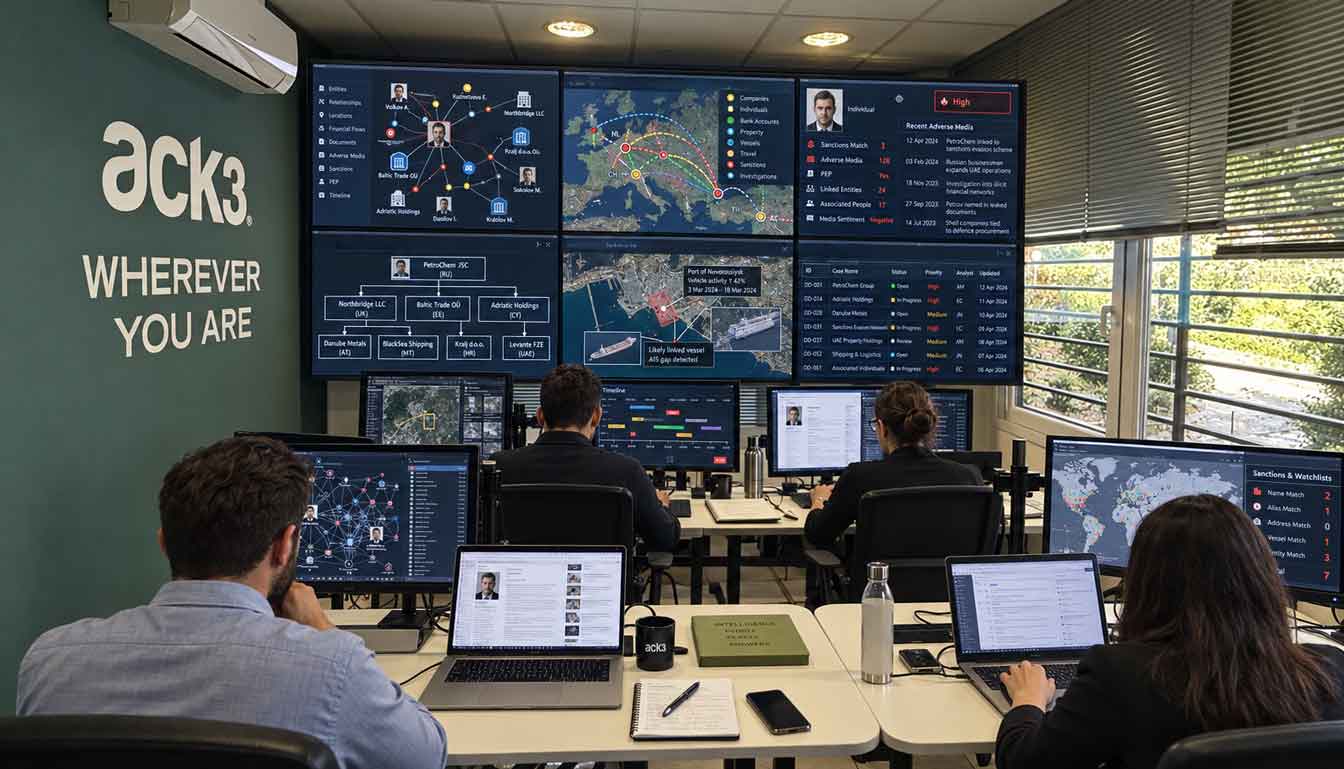
Corporate due diligence is the structured investigation of a company, individual or third party before an investment, acquisition, partnership, transaction or commercial contract. It combines corporate records analysis, beneficial ownership checks, background screening, litigation and sanctions research, market intelligence and reputational risk assessment to determine whether a counterparty is legitimate, transparent and aligned with the information it has disclosed. Effective due diligence goes beyond verifying stated facts: it identifies hidden ownership structures, regulatory exposure, undisclosed litigation, conflicts of interest, reputational concerns and inconsistencies that could create financial, legal or operational risk.
Why due diligence matters more than ever
The cost of a bad counterparty is rarely limited to the transaction itself. An undisclosed beneficial owner, an intermediary with a corruption record or a partner operating in a sanctioned supply chain can expose an organisation to regulatory enforcement, contractual loss, litigation across multiple jurisdictions and lasting reputational damage. In many markets, none of this appears in the documentation the counterparty provides — and none of it appears in a database screening either.
Effective due diligence closes that gap. It establishes who is really behind a company, how it actually operates, what it has been accused of, and what it stands to gain from the relationship it is proposing. Done before signature, it is a fraction of the cost of unwinding the consequences afterwards.
International standards require organisations to look through corporate layers to the natural persons who ultimately own or control a legal entity. Formal registry information alone is not sufficient where ownership is structured through nominees, trusts or offshore vehicles.
— FATF standards on beneficial ownership and transparency of legal persons
The overwhelming majority of foreign bribery schemes are executed through agents, distributors, consultants and other intermediaries — making third-party due diligence the single most consequential control in an anti-corruption programme.
Due diligence is expected to be risk-based, proportionate and ongoing. A verification carried out at onboarding and never revisited does not meet the standard where the risk profile of the relationship has materially changed.
— The Wolfsberg Group principles on financial crime risk management
What a rigorous due diligence process should cover
| Risk Vector | Criticality | What It Reveals and Why It Matters |
|---|---|---|
| Ultimate Beneficial Ownership (UBO) | Critical | Traces control through holding companies, nominees and offshore vehicles to the natural persons who actually own the counterparty — and to anyone deliberately kept off the paperwork. |
| Sanctions exposure | Critical | Detects direct and indirect links to designated persons, entities, vessels, sectors or jurisdictions, including exposure through ownership and control thresholds. |
| Financial standing & solvency | Critical | Assesses filings, trading history, insolvency records and group indebtedness to establish whether the counterparty can actually perform the obligations it is assuming. |
| PEP & political exposure | High | Identifies political influence, family and associate networks, state connections and the bribery and conflict-of-interest exposure they generate. |
| Litigation & regulatory record | High | Surfaces civil and criminal proceedings, enforcement actions, arbitration history and patterns of contractual dispute across every relevant jurisdiction. |
| Adverse media & reputation | High | Analyses local and international coverage, including local-language sources, to identify allegations and investigations long before they reach official databases. |
| Jurisdictional risk | High | Evaluates corruption levels, judicial independence, registry reliability, AML maturity and the practical enforceability of contracts in the relevant country. |
| Source of wealth & funds | High | Tests whether declared wealth is consistent with a verifiable commercial history, particularly for ultra-high-net-worth individuals and investment counterparties. |
| Third-party & supply chain risk | Medium-High | Maps indirect exposure through agents, distributors, subcontractors and intermediaries — the route through which most corruption liability actually arrives. |
| ESG & human rights exposure | Medium-High | Identifies labour, environmental and community concerns attached to the counterparty, its projects or its supply chain, now a growing source of regulatory duty. |
Choosing the right level of enquiry
Not every counterparty warrants the same depth of investigation, and applying the highest level indiscriminately is expensive without being safer. We recommend the level of enquiry after an initial risk assessment of the transaction, the jurisdiction and the profile involved.
| Level | Scope | Typically Applied To |
|---|---|---|
| Standard due diligence | Corporate verification, registry filings, shareholding, sanctions and PEP screening, litigation search and adverse media review from documentary and open sources. | Routine onboarding, lower-value contracts and counterparties in transparent jurisdictions. |
| Enhanced due diligence (EDD) | All of the above plus ownership tracing across jurisdictions, financial and litigation analysis in depth, local-language research, source-of-wealth verification and network mapping. | High-risk profiles, offshore structures, PEP-linked counterparties and significant transactions. |
| Investigative due diligence | Discreet in-country enquiries through vetted networks and human sources, providing operational context, market reputation and information that exists nowhere in writing. | Complex and opaque markets, disputed facts, unresolved red flags and pre-litigation matters. |
| Ongoing monitoring | Continuous review of ownership changes, sanctions designations, litigation, media and emerging risks throughout the life of the relationship. | Long-term partnerships, portfolio companies, supplier frameworks and regulated relationships. |
How we run a due diligence engagement
01 — Scoping and risk assessment
We establish what decision the report has to support, which subjects and jurisdictions are involved and what would constitute a deal-breaking finding. Scope, timeframe and fixed fee are agreed before any work begins.
02 — Documentary and corporate research
Corporate registries, regulatory filings, financial statements, insolvency and litigation records are collected across every relevant jurisdiction and cross-checked against what the counterparty has disclosed.
03 — Open-source intelligence and screening
Sanctions and PEP screening is combined with structured OSINT and local-language adverse media analysis, so that allegations and investigations are surfaced before they reach commercial databases.
04 — In-country enquiries
Where records are unreliable or the question cannot be answered from open sources, discreet enquiries are conducted through vetted local networks — without any approach that could compromise your position or the transaction.
05 — Analysis, grading and reporting
Findings are corroborated, graded for source reliability and separated clearly into confirmed facts, unresolved indications and matters requiring further work. The report opens with an executive summary and a risk assessment usable directly by boards, investment committees and counsel.
The failures we are most often asked to correct
Screening mistaken for due diligence. A clean database result confirms that a name does not appear on a list. In opaque jurisdictions, that is exactly what a well-structured problem looks like.
Ownership traced only to the first layer. Stopping at the registered shareholder — usually another company — leaves the actual controller unidentified and the regulatory obligation unmet.
English-only research in non-English markets. The allegation, the court filing and the press coverage that matter are frequently published only in the local language, and never translated.
Intermediaries left out of scope. Most enforcement exposure arrives through agents and distributors, yet they are routinely the least examined parties in the chain.
Onboarding treated as the end of the process. Ownership changes, designations are added and cases are opened after the contract is signed. Without monitoring, none of it is seen.
Who we work for
Our due diligence practice supports private equity funds and institutional investors assessing targets and co-investors; corporates entering new markets or appointing local partners, agents and distributors; law firms requiring investigative support for transactions, disputes and asset recovery; banks and regulated entities conducting enhanced due diligence on high-risk clients; and family offices and UHNW individuals verifying counterparties, advisers and investment opportunities before capital is committed.
THE ACK3® DUE DILIGENCE APPROACH
We combine documentary verification, financial and litigation analysis, open-source intelligence and discreet in-country enquiries conducted by professionals with a background in special mission support. Every finding is sourced, graded and assessed for what it means to your decision — never presented as inference dressed as fact. In complex and emerging markets, due diligence is not a compliance formality: it is the difference between a transaction you understand and one you have simply been told about.
What questions does a due diligence investigation answer?
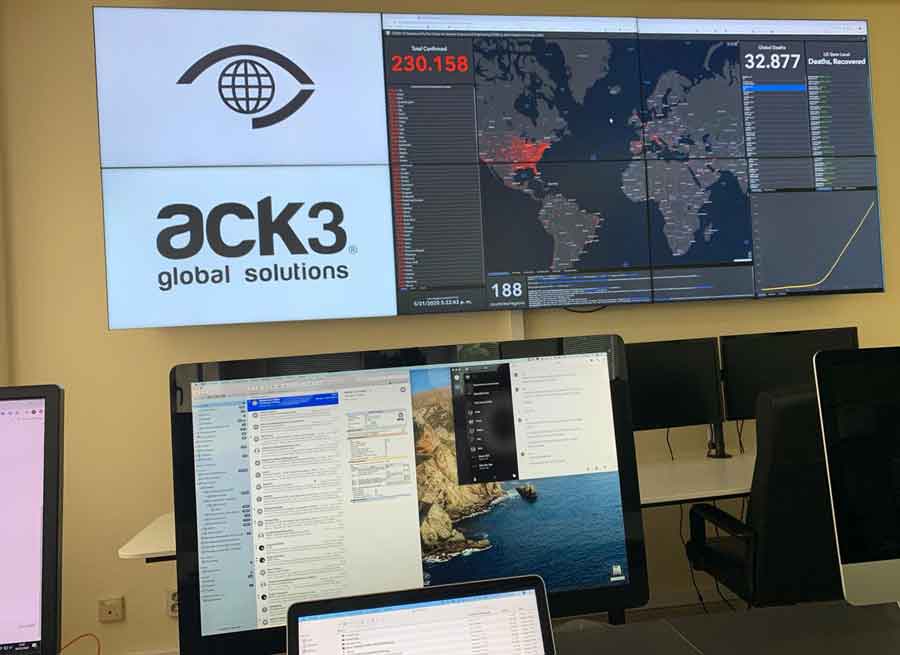
A due diligence investigation is commissioned to resolve a specific question about a counterparty, not to produce a generic file. The enquiries below are those ACK3 resolves most frequently for private equity funds, corporates entering new markets, law firms and family offices — combining corporate registry research, open-source intelligence and discreet in-country enquiries across jurisdictions where documentary records are unreliable.
WHAT OUR DUE DILIGENCE ANSWERS
› Fraud and misconduct. Contextual intelligence supporting investigations into alleged fraud or misappropriation of assets.
› Financial crime exposure. Tax evasion, sanctions breaches, terrorist financing, bribery and corruption allegations.
› Politically exposed persons (PEPs). Direct and indirect links, family and associate networks, and their consequences.
› Ultimate beneficial ownership (UBO). Control traced through nominees, trusts and layered offshore structures.
› Management integrity. Conduct and reputation of directors and shareholders, including undisclosed matters.
› Human rights and environmental risk. Concerns across operations, projects and supply chains.
› Source of wealth and funds. Verification of declarations made by ultra-high-net-worth individuals.
› Complex litigation. Status, exposure and enforceability across multiple jurisdictions.
All examples are anonymised. Client identities, jurisdictions and case details are never disclosed.
Why these questions cannot be answered by database screening alone
Database screening confirms whether a name appears on a list. It does not establish who controls a company through a nominee shareholder, whether a director’s reputation in the local market contradicts his filings, or why a supplier’s ownership changed three weeks before the tender. In jurisdictions where corporate registries are incomplete or actively misleading, a clean screening result is frequently what a well-structured problem looks like.
ACK3 resolves these questions by combining documentary verification, financial and litigation analysis, open-source intelligence and lawful in-country enquiries conducted through vetted local networks. Every finding is sourced, graded for reliability and separated into confirmed fact, unresolved indication and matter requiring further work.
Frequently asked questions about ACK3 Due Diligence services
What is due diligence and why does it matter?
What is the difference between due diligence and KYC?
What does ACK3’s due diligence service include?
What are the different levels of due diligence?
How long does a due diligence report take?
Which jurisdictions do you cover?
Is the process confidential, and will the subject find out?
Is due diligence legal, and how do you handle data protection?
Can you identify ultimate beneficial owners behind offshore structures?
What does the final report look like?
What happens if you find something concerning?
How much does a due diligence report cost?
Contact us
Are you interested in the ACK3 Due Diligence services?
Get in touch with us by completing the form below: