

HEAT – Hostile Environment Awareness Training
Hostile environment awareness training in Spain with international deployment capability
This course is designed by ACK3 to prepare individuals who will work or travel in high‑risk areas, such as conflict zones or regions with elevated crime rates. The training typically covers survival principles, basic first aid, navigation, emergency communication, and how to respond appropriately to threatening situations, including incidents such as kidnappings or attacks, always from a preventive and awareness‑based perspective.
What is HEAT?
Hostile Environment Awareness Training (HEAT) is a comprehensive security and preparedness program designed for individuals who plan to work or travel in high‑risk areas or environments where there is a significant threat of political or civil unrest, conflict, terrorism, or natural disasters. This type of training is particularly relevant for journalists, humanitarian workers, military and government personnel, and employees of international organizations and NGOs who may encounter potentially dangerous situations as part of their professional duties.
Duration
The ACK3 HEAT program is structured in two main formats, adapted to the participant’s required level of depth and operational needs:
-
Intensive Program (3 days – PFST): focused on essential competencies and immediate response
-
Full Program (5 days – HEAT): advanced development with complex simulations and extended scenarios
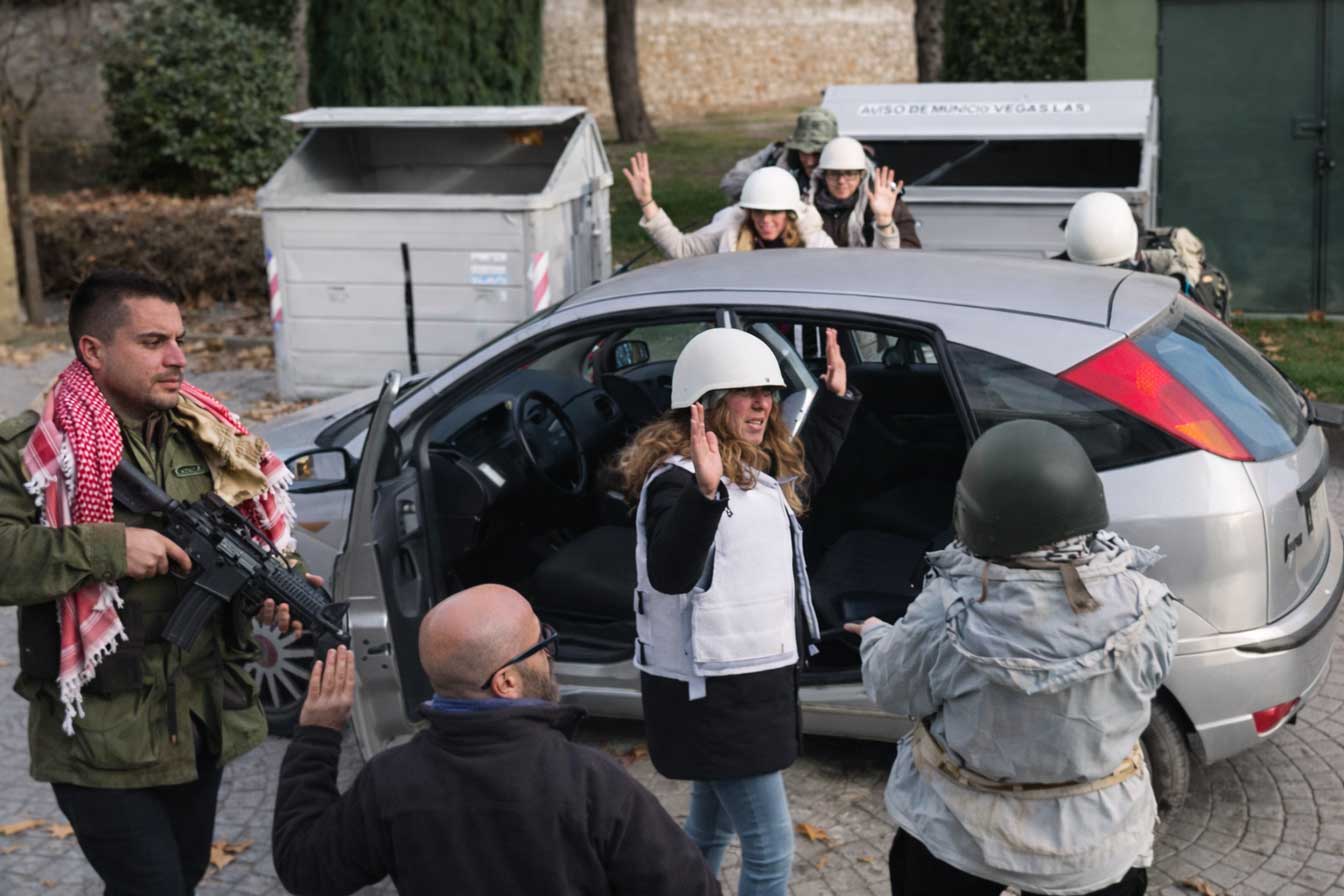
Training takes place in Spain, in environments specifically designed for the simulation of real operational scenarios, combining controlled urban areas with natural terrain that enables an immersive experience under stress conditions. Sessions are generally conducted at our facilities in a village in Castilla‑La Mancha, one hour from Madrid. There, we have more than 200,000 m² of facilities and natural environments ideal for this type of training.
“The only easy day was yesterday.”
Objective
The HEAT program aims to prepare participants to operate with sound judgment in high‑risk environments. Through a practical, applied approach, participants develop the ability to:
-
Anticipate threats before they materialize
-
Reduce their exposure to risk
-
Make decisions under pressure
-
Act effectively in critical situations
The focus is not only on knowledge, but on the ability to react in real‑world contexts.
Methodology
The HEAT training follows an experience‑based learning model:
80% practice | 20% theory
- Realistic simulations based on operational scenarios
- Real‑time decision‑making exercises
- Role‑play in crisis environments
- Immersive scenarios with controlled stress
Participants operate as a deployed team in an unstable environment, facing situations that demand decision‑making, coordination, and constant adaptation.
Contents
The program is designed to prepare participants to recognize, avoid, and respond to threats in complex environments. It is structured into four main modules:
1. Risk Anticipation
-
Risk assessment and management
-
Threat identification
-
Security planning
-
Situational awareness and security culture
2. Operating in a Hostile Environment
-
Safe mobility and movement across terrain
-
Navigation and orientation
-
Checkpoint management
-
Self‑protection protocols
3. Incident Response
-
Management of kidnappings and situations involving deprivation of liberty
-
Response to ambushes and direct threats
-
Planning and execution of evacuations
-
Communications in critical environments
4. Survival and Resilience
-
Tactical first aid (adapted TECC/TCCC)
-
Stress management and psychological resilience
-
Decision‑making under pressure
-
Teamwork and leadership in crisis


Participant Profile
The HEAT program is designed for professionals who operate—or will operate—in environments where risk is a real and inherent variable of their work.
-
NGO and humanitarian aid personnel
-
Journalists and correspondents
-
Diplomats and international organizations
-
Corporate staff deployed abroad
-
Field engineers and technical teams
-
Security teams
It is especially relevant for those working in contexts of:
-
High criminality
-
Conflict or post‑conflict
-
Political or social instability
-
Low‑governance environments
-
Areas exposed to natural disasters
Certification and Continuity
At the end of the program, participants receive an official ACK3 Academy certificate that validates the competencies acquired in security and operation within hostile environments.
But the training does not end there.
Participants become part of the ACK3 ecosystem, gaining access to:
-
Knowledge updates in response to emerging threats
-
Specialized content
-
Advanced training
-
Professional community (ACK3 Alumni)
After HEAT, you operate with sound judgment: you anticipate risks, reduce exposure, and make effective decisions under pressure.
Benefits
-
Reduction of personal risk through the learning of security and survival tactics
-
Improved ability to make decisions under pressure in high‑risk situations
-
Increased confidence to operate in dangerous environments using proven security protocols
-
Acquisition of practical skills in first aid, crisis management, and negotiation in emergency situations
-
Psychological preparation to manage stress and strengthen resilience in extreme conditions
The ACK3 HEAT course prepares participants to face risks in hostile environments, equipping them with key skills in security, first aid, navigation, and crisis response. Through a combination of theory and practical simulations, participants develop resilience, confidence, and the ability to operate effectively in high‑risk situations.
Upcoming editions
The new ACK3 Academy editions are designed for professionals, individuals and organizations seeking to enhance their preparedness, resilience and ability to operate in complex, international or high-pressure environments. Through practical methodologies, simulations and scenario-based training, the HEAT and PFST programs help participants develop capabilities applicable to risk management, personal security, decision-making under pressure, incident management and contingency preparedness.
Confirmed dates
Specialized training in security, operational preparedness and hostile environments.
PFST
Personal Field Security Training · Intensive 3-day program
HEAT
Hostile Environment Awareness Training · Full 5-day program
ACK3 BOOTCAMP
Intensive 5-day program
Are you ready to improve your operational capabilities and decision-making skills in complex environments?
Discover all the information, contents, methodology, and pricing at the following link:
Formalize registration here!
To formalize the registration and reserve a place, an initial payment of 15% of the total program fee will be required. This amount will subsequently be deducted from the final balance.
Contact us
Are you interested in the ACK3 Hostile Environment Awareness Training (HEAT)?
Get in touch with us by completing the following form:
Contáctanos
¿Estás interesado en los servicios de Hostile Environment Awareness Training (HEAT) de ACK3?
Ponte en contacto con nosotros completando el siguiente formulario: