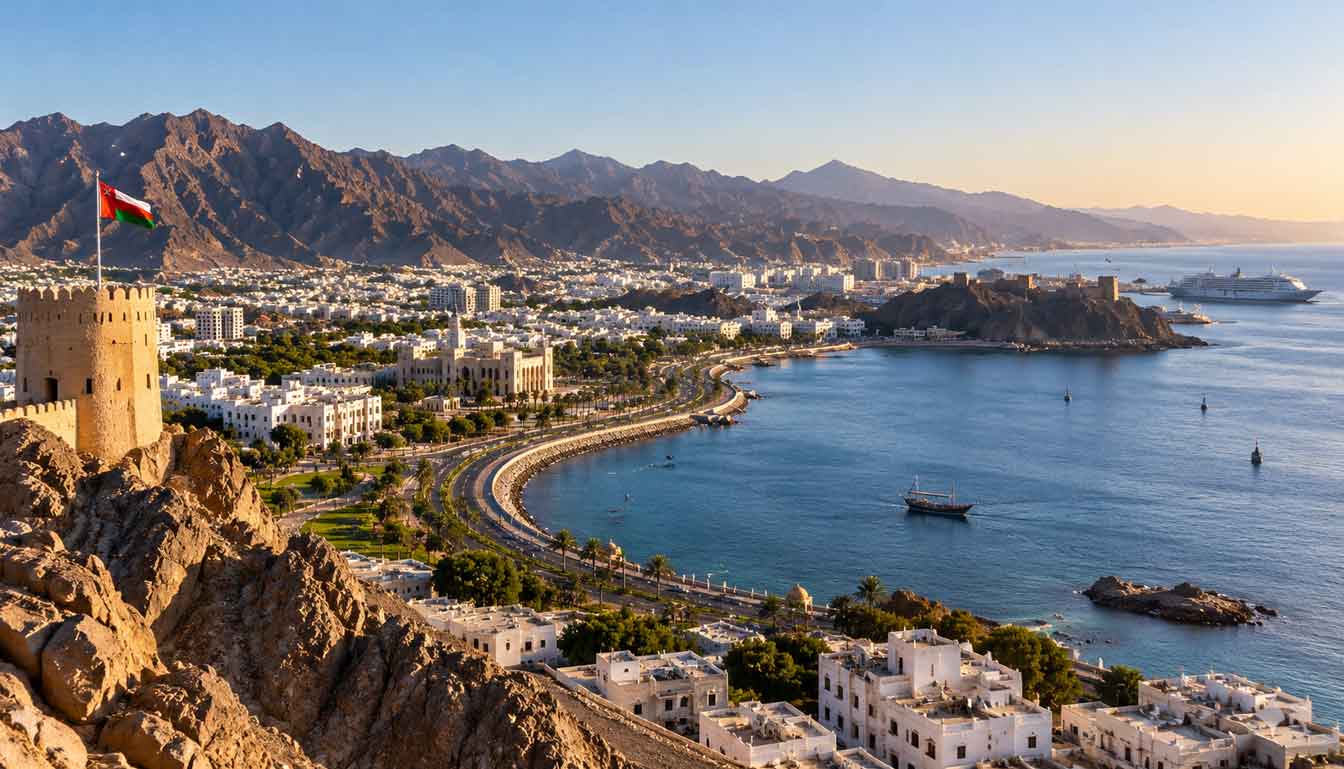
Muscat is not a tourist destination with business activity around it. It is the other way round: it is the Sultanate’s centre of decision-making, contracting and services, and the point every foreign company passes through before operating in Duqm, Sohar or Dhofar. The question is not whether Oman is of interest, but what is decided in Muscat and how prepared you arrive
The Omani capital concentrates the administration, the banking sector, international operators, diplomatic representations and virtually all of the country’s professional services. It is also going through a phase of accelerated urban transformation, structured around Oman Vision 2040, which is reshaping its waterfront, its hotel fabric and its supply of business land. For a foreign company, that transformation opens real opportunities. But understanding Muscat requires separating two planes that are frequently confused: public safety, which is notably good, and operational and environmental risk, which is rather less so.
The argument of this analysis is the following: in Muscat, the risk that matters to a foreign company is not criminal. It is operational and regional —mobility, extreme weather, air connectivity, airspace and business continuity— and it materialises in the project schedule, not in the office safe. Mistaking low crime for the absence of risk is the most frequent entry error.
hotel revenue (2025)
up from 49.9%
European visitors
index out of 100
That combination —sustained growth and a high perception of safety— explains why Muscat appears with increasing frequency on prospecting agendas. It also explains why many companies arrive with less preparation than they would deploy in a market perceived as hostile.
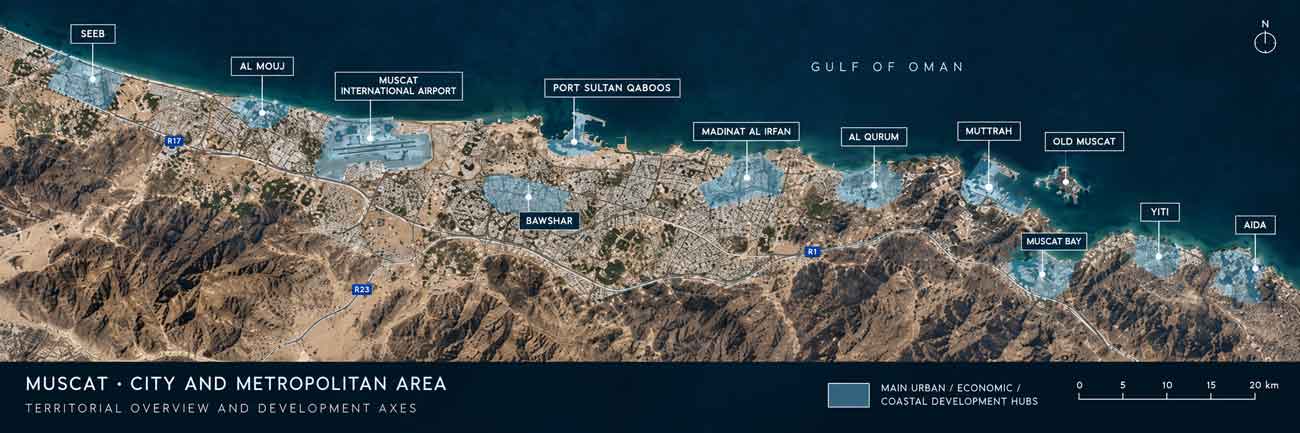
Source: own elaboration · ACK3® Global Hybrid SOC
The map sets out the capital’s territorial logic at a glance: a continuous coastal strip of more than 50 kilometres between Seeb and AIDA, compressed between the Al Hajar mountains and the Gulf of Oman, along which the international airport, the historic port, the new business district and the latest generation of coastal developments are aligned. That linearity is not an urban planning detail: it conditions routes, travel times and single points of failure in mobility.
“Muscat is the safest city in the Gulf in which we have seen companies arrive worst prepared. Precisely because the crime index is low, the environment analysis phase gets skipped and they go straight to the commercial meeting. The problem shows up later, when teams have to be moved, local hiring begins and a schedule has to be sustained.”
— Antonio García, Senior Operations Coordinator (GPC), ACK3® · Travel Risk Management
Muscat as an entry platform, not as a destination
The capital functions as the country’s principal air gateway and as the point of articulation with the rest of Omani territory. Its position between Europe, Asia and Africa gives it a relevance disproportionate to its size, and the evolution of its airport infrastructure responds directly to the need to accompany the growth projected to 2040. Added to that connectivity is the concentration in the city of public, financial and business services, which makes it the logical platform from which to assess entry into the Omani market before committing permanent structure. The market should nonetheless be sized correctly. Muscat operates at a smaller scale than the major Gulf centres, with a less developed leisure offer and a degree of seasonality in certain segments. Its direct connectivity with some European markets is also lower than that of the main regional hubs. The opportunity should therefore not be measured by growth in visitor numbers, but by the capacity to increase average spend, extend length of stay and develop higher value-added services. It is a margin market, not a volume market. For the geopolitical and port framework in which this city sits, see our country analysis in Oman: stability and business opportunity.
The coastline and the port as a strategic asset
Muscat combines beaches, bays, mountains and spaces suited to nautical activity, allowing urban, cultural, nature and maritime tourism to be integrated within a short radius. Sultan Qaboos Port, in Muttrah, constitutes a specific asset for cruise tourism and is undergoing conversion into a district of a tourism, commercial, residential and leisure character. Maritime development is not, however, limited to cruise traffic: it comprises marinas, recreational boating, port services, dining and maritime leisure. One example is the opportunity identified by Invest Oman to develop and operate a high-end yacht marina in Quriyat, with estimated investment of 37 million OMR.
The new map of urban development
Muscat’s transformation is structured through integrated destinations, not through standalone establishments. Reading the projects together explains the logic of the market better than any aggregate indicator.
| Development | Primary vector | Reading for the foreign supplier |
|---|---|---|
| Al Mouj Muscat | Marina, residential, hospitality and retail | An already consolidated reference model. Demand for facility management, maintenance, dining and nautical services. |
| Port Sultan Qaboos | Port conversion and urban district | Rehabilitation in a historic and operational environment. Engineering, interior design, wayfinding, site security and cruise passenger flow management. |
| Madinat Al Irfan | New urban and business centre | Incorporates the Oman Convention and Exhibition Centre. Opens the MICE segment and reduces dependence on leisure tourism. |
| Yiti | Sustainability, tourism and residential | Coastal axis with demanding environmental requirements. Water, energy, waste, efficiency and certification. |
| AIDA | Upscale and differential experience | Highest value per unit segment. Equipment, interior design, dining and specialised operation. |
| Al Qurum, Al Bustan, Jebel Sifah and Muscat Bay | Complementary coastal and urban portfolio | Smaller-scale schemes but with a nearer timeline. Usually the realistic entry route for a specialised SME. |
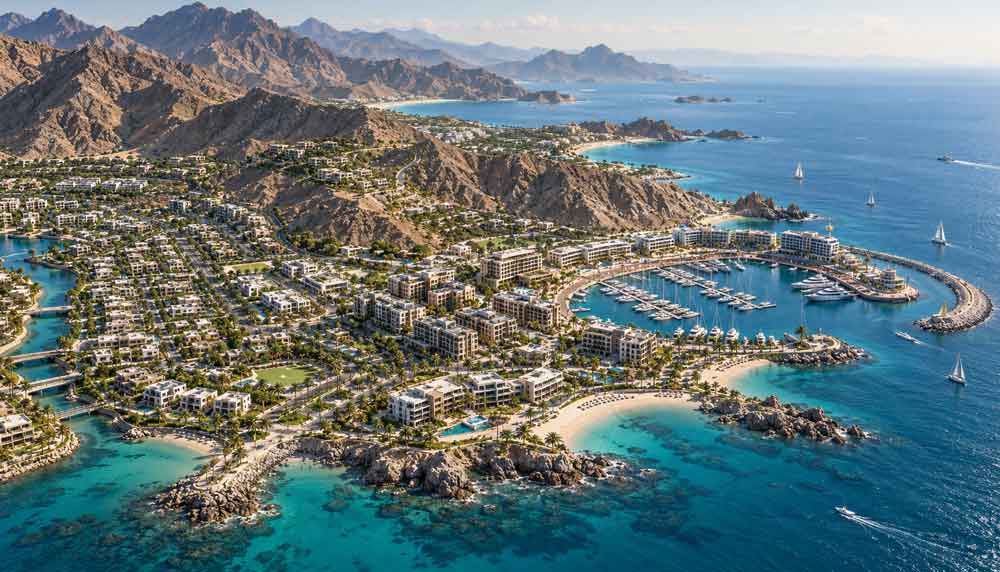
The image illustrates the change of model more clearly than any description: this is not about adding hotel rooms, but about building complete urban pieces —marina, hospitality, residential, retail and public space— that simultaneously generate demand for construction, for equipment and, afterwards, for operation and maintenance over decades. For the foreign supplier, the entry window is not only in the construction phase: it is in the layer of services that sustains the asset once delivered.
Where the Spanish company fits: the value chain
The most relevant element from a commercial perspective is that growth is generating activity far beyond the tourism sector itself. Major developments demand engineering, architecture, construction, maintenance, energy, water, waste treatment, digital technologies, telecommunications, transport, dining, security and facility management. That widening of the value chain multiplies the number of sectors open to foreign participation and favours collaboration models between Omani and international companies. The attraction, therefore, does not lie in competing with the major hotel operators, but in participating in the supply and services chain that accompanies their growth. The Spanish business base holds proven competitive capabilities in airport infrastructure, engineering, hotel management, construction, renewable energy, water treatment, mobility, port management and high value-added tourism. The potential for collaboration exists, but it must be analysed project by project: degree of maturity, access conditions, local partner, regulatory framework and contracting mechanism.
“The usual mistake is to ask whether it is worth establishing in Oman. The correct question is a different one: where a concrete need exists, who controls the decision, which projects have sufficient maturity and what partnership model is viable. That is answered with prior intelligence, not with a trade mission.”
— Antonio García, Senior Operations Coordinator (GPC), ACK3®
Security and operational risk in Muscat
Muscat presents a favourable environment for visitors, investors and expatriate personnel, with low levels of ordinary crime. Exposure to conventional crime is low and concentrated in opportunistic theft, minor property offences and interpersonal incidents, while serious violence against foreign nationals shows limited incidence. That said, the principal point of attention for the corporate sector is not urban crime, but indirect exposure to the regional environment and to a set of operational factors that rarely appear in the initial financial model.
| Factor | Exposure | Why it matters |
|---|---|---|
| Ordinary crime | Low | It does not condition the investment decision, but neither should it be extrapolated to the other vectors. |
| Road traffic accidents | Medium | It is the most likely cause of a serious incident for deployed personnel. It directly affects driving and transport policy. |
| Extreme weather and flash flooding | Medium | Wadis can cut off access in a matter of minutes. It affects mobility, works and service continuity. |
| Air connectivity and airspace | High | Regional developments can alter routes, cancel flights and block executive travel at short notice. |
| Supply chain and continuity | High | A regional delay translates into contractual penalties and cost overruns not foreseen in the original schedule. |
Numbeo’s perceived crime index places Muscat at 18.67 out of 100. It is an indicator built on user perceptions rather than official police statistics, and should therefore be used as a comparative reference rather than an absolute measurement.
The British and United States authorities maintain travel advice for Oman that contemplates possible flight and transport disruption arising from developments in the regional environment. Both are updated frequently and should be consulted on the date of travel, not on the date of planning.
— FCDO — Oman Travel Advice · U.S. Department of State — Oman Travel Advisory
The most common framing error
Treating public safety as though it were country risk. Muscat is a safe city and that condition is real and favourable for investment and executive travel. But physical security in destination and continuity of the operation are two different things. The risk that stops a project in Oman does not come through the office door: it arrives through the airspace, through the supply chain, through a wadi cut off in the rainy season and through the local partner who was not verified in time.
Before the first deployment
For a Spanish company, entry into Muscat should be approached on the basis of a specific market study carried out before any significant commitment of resources. That analysis should identify projects in planning, award and execution; developers and operators; supply and service requirements; international competitors; potential local partners; regulatory requirements and contracting mechanisms. Muscat can also be used as an initial platform from which to assess subsequent expansion towards Salalah (Dhofar), Duqm, Sohar and other development poles. In this context, ACK3® complements financial, legal and commercial analysis with strategic intelligence, risk analysis and operational assessment on the ground. The work can begin in the prospecting phase —environment analysis, counterparty assessment, risk mapping, route and accessibility analysis, site security assessment and travel risk assessment— and continue during establishment with environment monitoring, early warning indicators, scenario analysis and specialised support throughout the deployment. The differential value for management is not in receiving information, but intelligence that can be acted on: what is happening, why it matters, what impact it may generate and what decisions should be considered.
Are you entering Oman with the intelligence that decision requires?
ACK3® supports international organisations before, during and after operational deployment in the Gulf: environment analysis, counterparty verification, personnel preparation and response capability on the ground.
| ACK3® Service | What it delivers in Muscat |
|---|---|
| Strategic risk consulting | Country and city risk assessment, market entry strategy, and threat and vulnerability analysis applied to the specific project. |
| Due Diligence and economic intelligence | Verification of local partners, agents, distributors and contractors; corporate and reputational backgrounds and the real decision-making structure. |
| Crisis management and business continuity | Scenario planning, escalation protocols, logistical contingencies and response to regional disruption. |
| Travel Risk Management and monitoring | Analysis by destination and route, 24/7 monitoring from our global SOC in Madrid and real-time alerts on the operating environment. |
| Specialised training (HEAT) | Preparation of personnel deployed to demanding environments: incident response, first aid in critical incidents and decision-making under pressure. |
| Mission Support Services | Operational support on the ground for projects and establishments in Muscat and in newly developed poles such as Duqm or Dhofar. |
In Muscat, understanding the city is not a complement to the entry strategy. It is part of it.