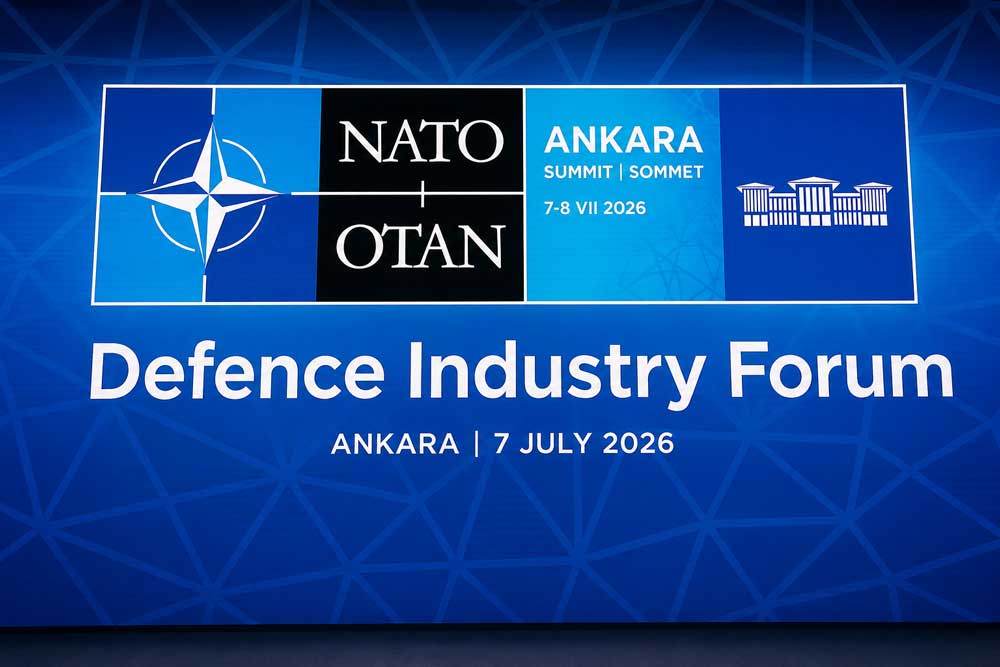
NATO’s 36th Summit, held in Ankara on 7-8 July 2026, marks the start of a new era for the Alliance and poses a strategic challenge for Europe’s defence industry: the next advantage will not be measured in platforms alone, but in the capacity to decide
For decades, the strength of a military alliance was measured by the number of soldiers, battle tanks, frigates or aircraft it could deploy. The Ankara Declaration shows that this logic is no longer enough. Without abandoning the principles that have defined NATO since its creation —collective defence, deterrence and the transatlantic bond—, the Alliance adds a different dimension: the ability to adapt, innovate and decide faster than any adversary. This is not a doctrinal revolution. It is the consolidation of an evolution that will likely define the coming decade.
What is the Ankara Declaration?
The Ankara Declaration is the final document of NATO’s 36th Summit of Heads of State and Government, held in the Turkish capital on 7-8 July 2026. It reaffirms the commitment to Article 5 and sets the Alliance’s priorities: over $50 billion in new equipment procurement, €70 billion for Ukraine in 2026, expansion of defence industrial capacity, an interoperable transatlantic combat cloud, and the adoption of advanced artificial intelligence models in the planning and execution of operations. Its underlying message: deterrence no longer depends on weapons alone, but on the speed at which the Alliance produces, adapts and decides.
+$50B
in new military equipment procurement agreed in Ankara
€70B
committed to Ukraine in 2026, with a similar level planned for 2027
+$139B
increase in defence investment by Europe and Canada in 2025
Industrial capacity becomes part of deterrence
One of the most significant messages from Ankara lies not only in the figures announced, but in what they are earmarked for. The Alliance speaks of increasing industrial production, accelerating innovation, removing barriers between allies, strengthening industrial resilience and adopting new technologies, including artificial intelligence. Industry ceases to be a mere supplier of military capabilities and becomes an essential part of the deterrence system itself. The ability to produce, sustain and evolve complex systems at high speed will matter as much as the military platform itself.
As NATO Secretary General Mark Rutte noted on the eve of the summit:
“What we need right now, the absolutely most crucial thing, is to ramp up production so we can transform this massive defence investment into combat power.”
The war of attrition in Ukraine has laid bare an obvious reality: no nation can sustain a prolonged conflict without a resilient industrial base deeply integrated with its allies.
The Ankara commitments, in figures
| Commitment | Scope | What it means |
|---|---|---|
| New procurement | Over $50 billion in military equipment | Faster production and delivery timelines |
| Support for Ukraine | €70 billion in 2026; similar level in 2027 | Sustained, multi-year demand for industry |
| Allied investment | +$139 billion from Europe and Canada in 2025 | Consolidation of the defence spending cycle |
| Technology | Transatlantic combat cloud + advanced AI | Interoperability and faster decision-making |
| Priority capabilities | Long-range precision strike, integrated air and missile defence, unmanned systems, space, cyber, intelligence | Real multi-domain integration, not isolated capabilities |
Source: Ankara Summit Declaration, NATO (July 2026).
Resilience is no longer just about recovery
For years we have associated resilience with business continuity or recovery after a crisis. Today’s strategic context forces us to broaden that definition. Resilience means sustaining the mission, preserving the capacity to decide and continuing to generate operational effects while the environment changes constantly. It ceases to be a recovery mechanism and becomes a strategic advantage. The winner is not the one who recovers best. The winner is the one who keeps the ability to act while the adversary loses theirs.
Multi-domain warfare demands multi-domain organisations
The Ankara Declaration reflects a fully multi-domain vision. Nuclear, conventional, space, cyber and missile-defence capabilities, unmanned systems and artificial intelligence are no longer understood as independent capabilities but integrated into a single operating system. Yet technological integration alone does not guarantee the advantage. The real challenge is to also integrate people, processes, information and leadership. Technological superiority without organisational superiority will hardly be decisive.
Decision advantage will be the true multiplier
Artificial intelligence, the combat cloud, distributed sensors and autonomous systems will exponentially increase the volume of available information. But having more information does not necessarily mean making better decisions. The differentiating factor will remain the ability to turn that information into shared understanding and timely decisions. Decision speed is becoming a strategic resource. Military superiority is evolving into decision superiority.
An opportunity for European industry
The Ankara Declaration also sends a clear political message: a stronger Europe within a stronger NATO. It does not propose replacing the transatlantic bond, but assuming greater collective responsibility in capabilities, innovation and industry. That scenario opens an extraordinary opportunity for the European Defence Technological and Industrial Base. But it also demands an evolution. Better platforms will not be enough. It will be necessary to develop better decision systems, better resilience models, better intelligence capabilities, greater interoperability and greater readiness to operate in hybrid, multi-domain environments.
Beyond risk
At ACK3 we see this evolution as part of a broader transformation. For years, organisations have focused their efforts on identifying risks and protecting assets. Today the challenge is different. The question is no longer only what might happen, but how to keep deciding and acting when it does. That means evolving from risk management to resilience; from resilience to operational endurance; and from endurance to true decision superiority.
The key idea
The next strategic advantage will not belong solely to those with better weapons. It will belong to those able to understand sooner, decide sooner and sustain that capacity alongside their allies when uncertainty is at its highest.
That may well be the main message Ankara leaves behind. And it is a responsibility shared by governments, armed forces, industry and the entire European security and defence ecosystem.
Is your organisation ready to decide when uncertainty is at its highest?
At ACK3 we help governments, armed forces and the defence industry turn information into decision superiority.
| ACK3 capability | What it delivers |
|---|---|
| Strategic Intelligence | Early understanding of the strategic, industrial and geopolitical environment |
| Risk Intelligence & Decision Support | Actionable intelligence embedded in executive decision-making |
| Wargaming and Decision War Room | Training decision-making under pressure in hybrid, multi-domain scenarios |
| Resilience and operational endurance | Sustaining the mission and the ability to act while the environment changes |