
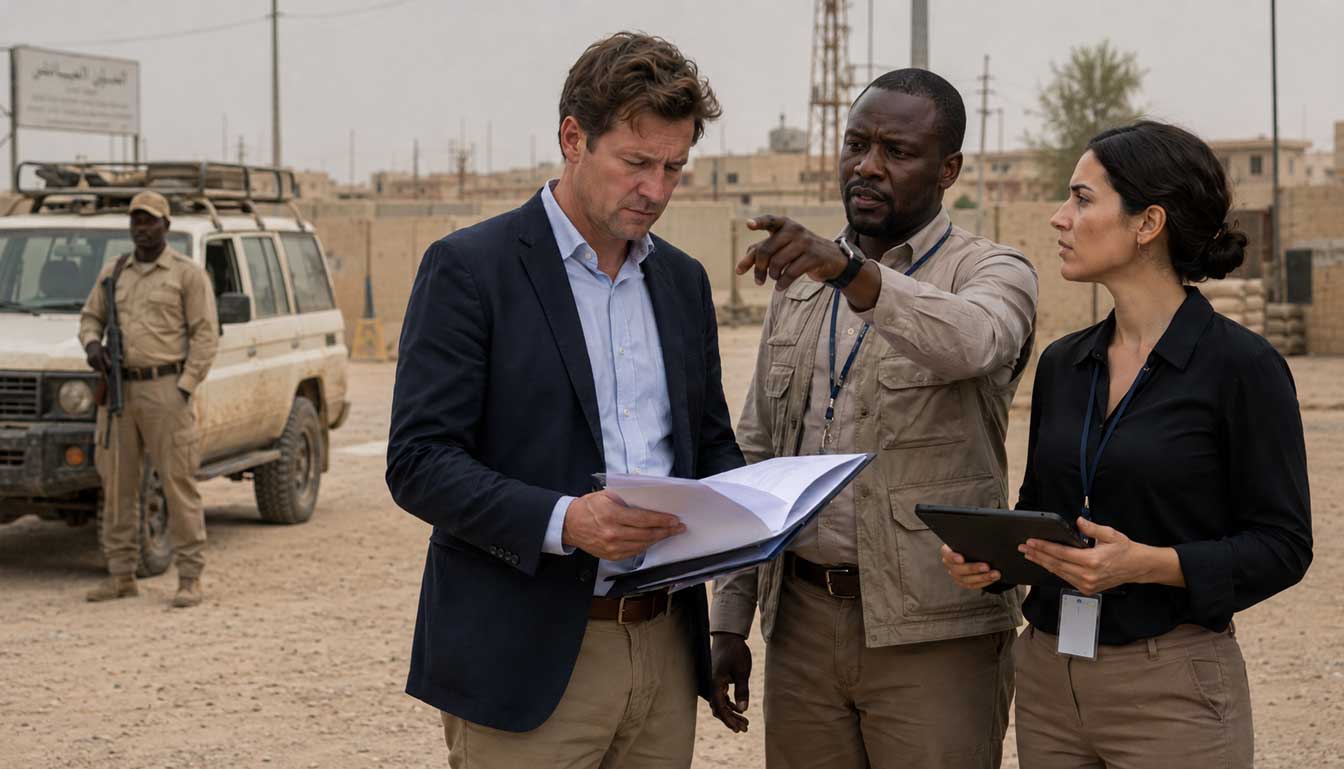
Who signs, who translates, who fixes it when it breaks? Most organisations entering a new market resolve local presence with an informal arrangement — and only discover what they contracted when something goes wrong.
When an organisation wins a project in an unfamiliar jurisdiction, the commercial question is settled long before the operational one. There is a contract, a schedule and a team ready to travel. What there rarely is: a legal entity, a bank relationship, a payroll route, someone who can file with the regulator, and someone who can read what the regulator sends back. Those gaps get filled quickly, locally and informally — and that improvisation becomes the organisation’s real exposure in country.
On-the-ground outsourcing is not administrative support. It is the delegation of three functions that determine whether an organisation can legally, operationally and linguistically exist in a country: the administrative layer that keeps it compliant, the operational layer that keeps it running, and the linguistic layer that determines what it actually understands and signs. Outsourced without structure, those three functions are also three unmanaged liabilities.
Setting up a subsidiary takes months and only makes sense once the pipeline justifies it. Meanwhile the project has already started. The usual solution is a local intermediary — a consultant, an agent, a contact recommended by someone else in the sector — who opens doors, handles paperwork, arranges vehicles and interprets in meetings. It works, up to a point. The problem is that this arrangement concentrates administrative authority, operational control and linguistic access in a single person or firm that the organisation has not assessed, cannot easily replace, and often cannot independently verify. Every document the organisation signs, every declaration it files and every commitment it makes in a meeting passes through that channel — and its understanding of what it signed depends entirely on how that channel chose to explain it.
The three layers, and why they are usually treated as one
Administrative, operational and linguistic support are distinct functions with distinct risk profiles. Bundling them into one relationship is convenient, and it is precisely where the exposure concentrates.
| Layer | What it covers | What goes wrong when it is informal |
|---|---|---|
| Administrative | Company registration and permits, tax and social security filings, payroll for local staff, invoicing, banking, contract administration. | Filings made late or wrongly in the organisation’s name; liabilities accruing silently; no audit trail when a regulator or a parent-company auditor asks. |
| Operational | Offices and accommodation, vehicles and drivers, movement of people and equipment, local suppliers, facilities and site support. | Suppliers selected on relationships rather than criteria; no continuity if the intermediary withdraws; duty of care obligations discharged by nobody in particular. |
| Linguistic | Interpretation in meetings and inspections, translation of contracts, technical documentation and regulatory correspondence, terminology consistency. | The organisation only knows what the interpreter chose to convey; technical terms drift between documents; a mistranslated specification becomes a contractual dispute. |
The OECD’s analysis of concluded foreign bribery cases found that intermediaries — local agents, consultants, distributors and brokers — were involved in the large majority of them, making the third party the single most common vector of corporate exposure abroad.
Under the UK Bribery Act, an organisation can be liable for bribery committed by an “associated person” performing services on its behalf — including agents it never directly employed. The defence is having had adequate procedures in place beforehand, not discovering the problem afterwards.
The four most common errors
| Frequent error | What is assumed | What the real risk is |
|---|---|---|
| One intermediary for everything | A single trusted contact is simpler and cheaper than three relationships | No separation of duties. The person who arranges the payment also explains what it was for, and the organisation has no independent way to check |
| The interpreter as a neutral channel | Interpretation is a technical service without influence on the outcome | The interpreter decides what is emphasised, softened or omitted. Where they hold an interest in the deal, that is not a language service — it is an exposure |
| Compliance ends at head office | Anti-bribery and sanctions policy applies to the parent company’s own staff | Under most extraterritorial regimes, conduct by a local agent acting on the organisation’s behalf can engage the organisation. Not knowing is not a defence |
| No exit plan | The arrangement can be ended whenever the organisation decides | Registrations, bank signatures, leases and staff contracts may sit in the intermediary’s name. Ending the relationship means losing the country |
US enforcement guidance is explicit that companies can be held responsible for payments made by third parties acting on their behalf, and that risk-based due diligence on those third parties is a core element of an effective compliance programme.
The most underestimated risk: the unassessed intermediary
In most market entries the concentration of risk is not in the regulatory framework or the security environment — it is in one person. The local agent who registered the entity, holds the bank mandate, employs the staff, selects the suppliers and sits in every meeting as interpreter. That person is frequently competent and frequently honest. But the organisation has usually assessed them on the strength of a recommendation, not through a process: no verification of ownership and affiliations, no check on political exposure or litigation history, no separation between who spends and who reports. If that assessment has never been done, the organisation has not outsourced a function. It has transferred control of the country to an unverified third party — and retained all the liability.
In defence of the fixer — and why he is not the problem
There is a version of this argument that treats the local fixer as a liability to be eliminated. It is wrong, and anyone who has worked in a complex environment knows it. The person who gets a container released, finds the one official who can actually sign, knows which road is closed today and which hotel is genuinely safe is not a bureaucratic convenience — they are the difference between a project that moves and a project that sits. That kind of judgement cannot be procured from a head office, it does not appear in any procedure manual, and it takes years of living somewhere to acquire. The problem is never the fixer. It is the absence of a structure around him. A resourceful local operator working inside a defined mandate, with verified credentials, separated financial authority and a documented trail, is one of the most valuable assets an organisation can hold in country. The same person, working informally, holding the bank mandate and interpreting his own arrangements, is the organisation’s single point of failure. Same individual, same skills — the difference lies entirely in how the relationship was built.
The question that is rarely asked
If your local representative stopped answering the phone tomorrow, what would you still hold? The registration, the bank mandate, the staff contracts, the supplier relationships, the correspondence with the regulator — in whose name are they, and in which language do they exist? The answer to that question is the real measure of how much of the country you actually control.
Where this matters most
The exposure rises with the distance between the organisation’s home framework and the local one. It is most acute in three situations: jurisdictions where a foreign entity cannot easily open a bank account or hire directly without a local partner; markets where the working language of regulation and contracting is not the organisation’s own; and environments where the security or political picture can shift faster than a governance structure can be rebuilt. The pattern repeats across ACK3’s areas of operation. In LATAM, energy and infrastructure projects combine local content requirements with fast-moving socio-political environments. In Sub-Saharan Africa, foreign entities frequently cannot bank or hire without a local partner, which concentrates authority by default. In the Middle East, defence and technical programmes run on Arabic-language contracting and regulatory correspondence, where a translation error is not a nuance but a contractual position. The common factor is not the region — it is the distance between what the organisation signs and what it can independently verify. Energy and infrastructure projects concentrate all three conditions at once. So do defence and technical programmes, humanitarian operations and academic or research deployments — any activity where people, equipment and legal obligations arrive in a country before the organisation itself does.
What a structured on-the-ground outsourcing model includes
The alternative to an informal arrangement is not a subsidiary. It is a defined structure with separated functions, verified counterparts and a documented trail.
| Component | What it contributes |
|---|---|
| Counterpart due diligence | Verification of local partners, agents, suppliers and staff before they are given authority — ownership, affiliations, political exposure, litigation and sanctions screening. |
| Separation of functions | Administrative, operational and linguistic responsibilities assigned to different parties, so that no single counterpart both acts and reports on the action. |
| Defined mandate for local operators | The fixer’s resourcefulness retained, with the scope of their authority written down: what they can commit, what they cannot, and who approves the difference. |
| Independent linguistic capability | Interpreters and translators contracted by the organisation, briefed on its terminology and with no interest in the transaction they are interpreting. |
| Documented trail | Filings, payments, approvals and correspondence recorded in a form the parent company can audit — and in a language its auditors can read. |
| Continuity and exit design | Registrations, mandates and contracts held in the organisation’s name, with a defined route to replace any counterpart without losing the market. |
Frequently asked questions
What is on-the-ground outsourcing?
The delegation of administrative, operational and linguistic functions to local providers in a country where the organisation has no established structure of its own. It covers registration and filings, logistics and facilities, and interpretation and translation — the three things an organisation needs in order to operate legally and effectively before it has an entity of its own.
How is this different from an employer of record or a PEO?
An employer of record solves employment. It does not assess your counterparts, coordinate movement in a difficult environment, or give you an independent linguistic channel. On-the-ground outsourcing is broader and is built around a risk question rather than a payroll one — which is why it belongs alongside due diligence and operational security rather than inside HR.
When does it make sense to set up a subsidiary instead?
When the pipeline is durable enough to justify the cost and the governance burden of a permanent entity. Until then, a structured outsourcing model gives the same operational capability with a fraction of the commitment — and, done properly, leaves the organisation holding the registrations and relationships if it later decides to incorporate.
Do we have to replace our existing local contacts?
Usually not. In most cases the people already in place are competent and worth keeping. What changes is the structure around them: verification, a defined mandate, separated authority and a documented trail. The objective is to protect a working relationship, not to dismantle one.
How long does it take to put in place?
It depends on the jurisdiction and on how much is already committed. Counterpart verification and a review of existing arrangements can be delivered quickly; restructuring registrations, mandates and contracts takes as long as the local administration takes. The earlier it is addressed, the less there is to unwind.
Do you control your country presence — or does someone else?
ACK3® provides administrative, operational and linguistic support on the ground for organisations operating in markets where they have no established structure of their own. Our model separates functions, verifies counterparts and leaves the organisation holding what matters — with the trail to prove it.
| ACK3® Service | What it includes |
|---|---|
| Market entry support | Administrative set-up, local representation, regulatory navigation and counterpart identification in unfamiliar jurisdictions. |
| Due diligence & counterpart verification | Assessment of local partners, agents, suppliers and key personnel before authority is delegated to them. |
| Mission Support Services | Security, monitoring and operational support for the people deployed to run the operation on site. |
| Linguistic Solutions | Interpreters, technical and legal translation and terminology management, contracted independently of the local counterpart. |
| Logistics support | Movement of people and equipment where infrastructure, customs or access make it a specialist task. |
Local presence built informally is not cheaper. It is simply unpriced — until the day the organisation needs to prove what it signed, in a language it cannot read, through a person it never verified. ACK3® builds it properly. Wherever You Are.