In an environment where mobile devices have become constant sensors, security no longer depends solely on software. A switched-off smartphone can still be tracked, a connected car can transmit location data, and a laptop can become an entry point for a remote attack. This is why more and more organizations use Faraday bags, cases designed to completely block electromagnetic signals. Governments, security forces, intelligence consultancies, and companies that handle sensitive information rely on this type of protection when they need to ensure that a device is fully isolated.
This is not technological paranoia. In a context where digital espionage, commercial tracking, and data exploitation are part of everyday life, controlling the emissions of our devices has become a matter of operational security.
What is a Faraday bag?
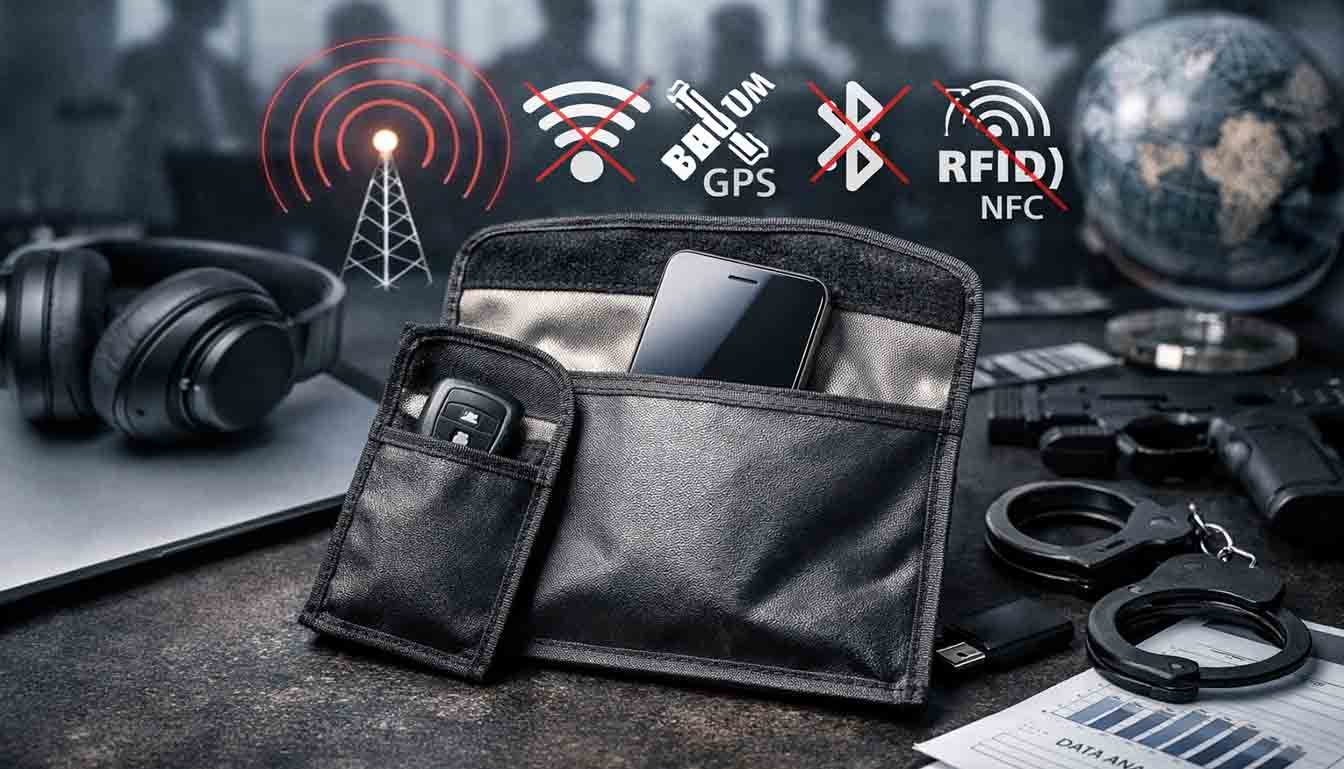
A Faraday bag is a pouch made from conductive materials that act as a Faraday cage, a physical principle discovered in the 19th century that blocks electromagnetic waves. When a device is placed inside such a bag, all its communications are cut off: cellular signal, Wi-Fi, Bluetooth, GPS, RFID, and NFC. This means the device cannot send or receive information. It also cannot be located or access external networks. The protection does not depend on the operating system or the state of the device. Even if the device is turned on, its signals are completely isolated as long as it remains inside the bag.
Why they are becoming increasingly important
For years, these bags were tools used almost exclusively by forensic laboratories and police units. Today, their use has expanded to companies, executives, and professionals who work with sensitive information.
The reasons are clear:
- Protection against tracking
Many devices constantly transmit location data. A Faraday bag prevents that signal from leaving the device. - Prevention of remote cyberattacks:
If the device has no connection, it cannot be attacked from outside. - Security in sensitive meetings:
By isolating phones and wearables, the remote activation of microphones or cameras can be prevented. - Custody of digital evidence:
Security forces use these bags to preserve seized devices, ensuring they cannot be remotely erased.
Real-world use cases
- High-level meetings
In governmental or corporate settings, it is common for attendees to place their phones in Faraday bags before entering the room. The goal is to prevent any possibility of eavesdropping or information transmission. - Vehicle protection
Car thefts using relay attacks have increased in recent years. Criminals amplify the signal from smart keys to unlock the vehicle. Storing keys in a Faraday bag blocks that signal and neutralizes the attack. - International travel:
Executives and journalists traveling to countries with high surveillance risks use these bags to prevent their devices from being monitored.
What digital security experts say
The NSA and other security agencies recommend physical isolation measures when handling sensitive devices. The reason is simple:
“Controlling electromagnetic emissions is an essential part of information security.”
In other words, technological protection does not always mean installing more software; sometimes it means reducing the exposure surface.
A small accessory with a big impact
Faraday bags do not replace other cybersecurity measures, but they add a critical layer of protection in certain contexts. When information is sensitive or the exposure to risk is high, physical isolation remains one of the most effective measures. In security, sometimes the best defense is simply cutting the connection.