Six Spanish coaches reached every major European final in the 2025/26 season. The football headlines tell one story. The strategic one runs much deeper.
In May 2026, something unprecedented happened in European football: every major continental final — the UEFA Champions League, the Europa League, the Conference League, and both the men’s and women’s competitions — featured at least one Spanish coach on the touchline. Six Spanish managers. Every final. One season. The sports media covered it as a football story. It is not only that. It is a signal about something Spain has been quietly exporting for decades — and that global organisations are only now beginning to fully understand.
European final, 2025/26
won by Spanish managers
for Luis Enrique (PSG, 2026)
New Jersey, July 2026
The World Cup: the final proof that the team beats the individual
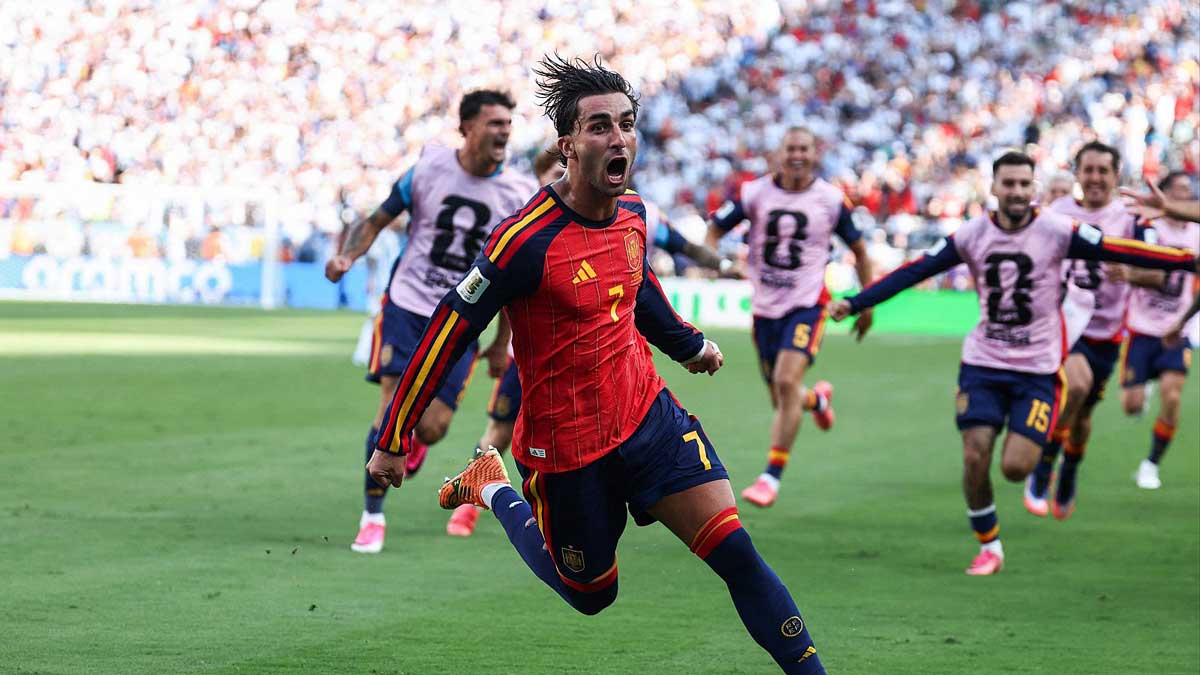
Source: RTVE — Video capture, FIFA World Cup 2026 Final
On 19 July 2026, at MetLife Stadium in New Jersey, Spain defeated Argentina 1-0 in extra time to win their second FIFA World Cup. The match itself was the most concentrated expression of the Spanish method yet seen on a global stage. Spain took 20 shots to Argentina’s three. They conceded just one goal across the entire tournament — the fewest of any World Cup champion in history. And the winning goal was scored in the 106th minute by Ferran Torres, a substitute who had not started the match. No individual star. No single moment of individual brilliance. A system, working collectively, until the moment it needed to produce. Torres himself summarised it perfectly after the final whistle: “It was a goal scored by 47 million people.” That sentence captures something that goes well beyond football. It describes an organisational culture where collective performance is the competitive advantage — not the exceptional individual, but the system that makes every individual perform beyond their individual ceiling.
“Spain claimed ultimate glory in front of a crowd of over 80,000 at New York New Jersey Stadium. They were crowned FIFA World Cup champions on Sunday 19 July 2026 — World Cup winners in 2010, Spain lifted the Trophy for a second time after defeating three-time champions Argentina 1-0 after extra time.”
— FIFA.com — Official World Cup 2026 Final Report, July 2026
“They are the most dominant defensive team to win a World Cup; no champion before them had ever conceded only one goal en route to a title. It marked their 38th consecutive match without a loss — a run that includes their trophy in the 2024 European Championship.”
Intelligence is only as good as the decision it enables
Spain knows how to read the game before it starts. The analytical work, the preparation, the scenario planning — that is the Spanish method at its best. But as any strategist will tell you, intelligence without decision-making is just information. The organisations — and the nations — that convert analytical advantage into real outcomes are those where the right people act on what they know, before the moment passes. At ACK3®, we transform intelligence into decision-making capability. The rest is up to the people in the room.
Spain does not only export players, products or services. It exports a method: a way of reading complex environments, building cohesive teams, designing adaptable strategies and making decisions under pressure. The international success of Spanish coaches is not a sporting coincidence. It is the visible expression of a deeper national capacity — one that transfers directly to the world of international business, risk management and organisational resilience.
The Spanish method: what coaches and strategists share
When Mikel Arteta took Arsenal to the Champions League final, when Luis Enrique lifted the trophy for the third time with PSG in Budapest, when Unai Emery extended his record Europa League haul to five titles with Aston Villa — the question worth asking is not what they achieved, but how. Spanish coaches did not arrive at foreign clubs as stars. They arrived as analysts. They studied the environment, understood the culture, diagnosed the weaknesses, built trust with individuals of different backgrounds and then converted individual talent into collective performance. That process — environmental reading, cultural adaptation, team cohesion, decision-making under pressure — is not unique to football. It is what effective international leadership looks like in any complex environment. The same capabilities that make a Spanish coach competitive at Arsenal, Aston Villa or PSG are the capabilities that make an organisation competitive in markets characterised by geopolitical complexity, regulatory uncertainty and operational volatility.
“Resilience is often described as the ability to withstand shocks. But in today’s environment, it is equally about agility — the capacity to pivot rapidly when situations change.”
— McKinsey & Company — Leading amid geopolitical upheaval, November 2025
“Leadership decisions on growth targets, intermediaries and incentives are, in practice, integrity decisions. A country experiencing persistent institutional decline may require enhanced due diligence, stronger local compliance safeguards or more careful partner selection.”
— World Economic Forum — How the CPI 2025 is reframing business strategy, February 2026
What the Spanish school of leadership actually looks like
Across coaches as different in style as Pep Guardiola, Luis Enrique, Unai Emery, Mikel Arteta or Íñigo Pérez, a common set of competencies emerges. They are not coincidental. They reflect a shared formation — one shaped by a football culture that has consistently prioritised intelligence over physicality, collective organisation over individual brilliance, and long-term structure over short-term improvisation.
| Capability | On the pitch | In the organisation |
|---|---|---|
| Environmental reading | Analysing the opponent before designing the game plan | Understanding the market, the regulatory context and the competitive landscape before entering |
| Cultural adaptation | Leading multicultural squads across different leagues and countries | Operating in complex geopolitical environments with different regulatory, cultural and institutional logics |
| Decision-making under pressure | Tactical adjustments in real time with incomplete information | Crisis management, escalation protocols and strategic decisions when the environment deteriorates |
| Collective performance | Converting individual talent into coordinated team output | Building organisations capable of maintaining operational continuity under stress |
| Anticipation over reaction | Designing game plans that force the opponent into known scenarios | Intelligence-led strategy that identifies risks and opportunities before they materialise |
Spain’s competitive export: not just talent, but a way of thinking
The 2025/26 European season offered a uniquely concentrated image of what Spain has been building for decades. Six Spanish coaches led their teams to European finals across men’s and women’s competitions — from the Champions League final in Budapest between PSG and Arsenal to Rayo Vallecano’s historic Conference League appearance. Since the 2010s, Spanish managers have dominated the Europa League, winning nine titles between 2010 and 2026 and accumulating the most overall titles of any nationality. But the more significant statistic is this: these coaches were not leading Spanish clubs. They were leading English, French and Spanish clubs that had placed their trust in a foreign professional to transform their organisations. That is the real export — not players, but a methodology of leadership that travels across cultures, languages and institutional contexts and consistently produces results.
“What we see in these coaches is exactly what we try to deliver at ACK3: the capacity to read an environment others find opaque, build a plan adapted to that specific context and help organisations make better decisions when the stakes are highest. Spain has always been good at operating under pressure — in football, in business, in security risk management. That is not a coincidence. It is a culture.”
— Jorge Ventura, Marketing & Communications, ACK3
From the touchline to the boardroom: what organisations can apply
The translation from football to business is not metaphorical. It is structural. The challenges that Spanish coaches navigate in European competition — operating in unfamiliar environments, managing multicultural teams, making strategic decisions with incomplete information, maintaining performance under sustained pressure — are identical in nature to the challenges international organisations face when expanding into complex markets. The difference is that in business, the consequences of poor environmental reading, inadequate preparation or slow decision-making are not a lost match. They are a failed market entry, a compliance breach, a crisis that could have been anticipated or a reputational exposure that takes years to resolve.
The competitive advantage that transfers
Read the environment before others do. Anticipate risk and opportunity. Design an adaptable strategy. Coordinate multicultural teams. Make decisions under pressure. Build organisations resilient enough to keep performing when the context changes. These are not football skills. They are the capabilities that define competitive organisations in complex international markets — and the capabilities that ACK3® was built to deliver.
ACK3®: strategic intelligence for organisations that operate where others hesitate
ACK3® is a strategic risk and decision advisory consultancy operating across Europe, the Middle East, Africa and Latin America. From our Global Hybrid Security Operations Centre (SOC) in Madrid — monitored 24/7 — we provide real-time operational intelligence, geopolitical analysis, travel risk management, due diligence and crisis response to international organisations operating in complex environments. Our SOC integrates open-source intelligence (OSINT), human intelligence networks, geopolitical monitoring and threat analysis to give organisations the situational awareness they need to make decisions before the environment forces them to react. We track over 100 countries, covering security incidents, regulatory changes, sanctions developments, political volatility and operational disruption — in real time. Like the Spanish coaches who arrive at foreign clubs not as tourists but as professionals who have done the analytical work before setting foot in the building, ACK3® operates from a simple principle: the organisations best positioned to grow internationally are those that understand their environment better than their competitors do.
Does your organisation have the intelligence it needs to compete internationally?
ACK3® helps international organisations anticipate uncertainty, strengthen resilience and make better decisions so they can operate, grow and compete across borders. From real-time monitoring to geopolitical analysis, due diligence and crisis management — wherever you are.