ACK3, a Spanish strategic intelligence and risk management consultancy, combines its service to companies and institutions with a clear commitment to young talent: giving those training in intelligence the professional environment in which to turn their education into real experience.
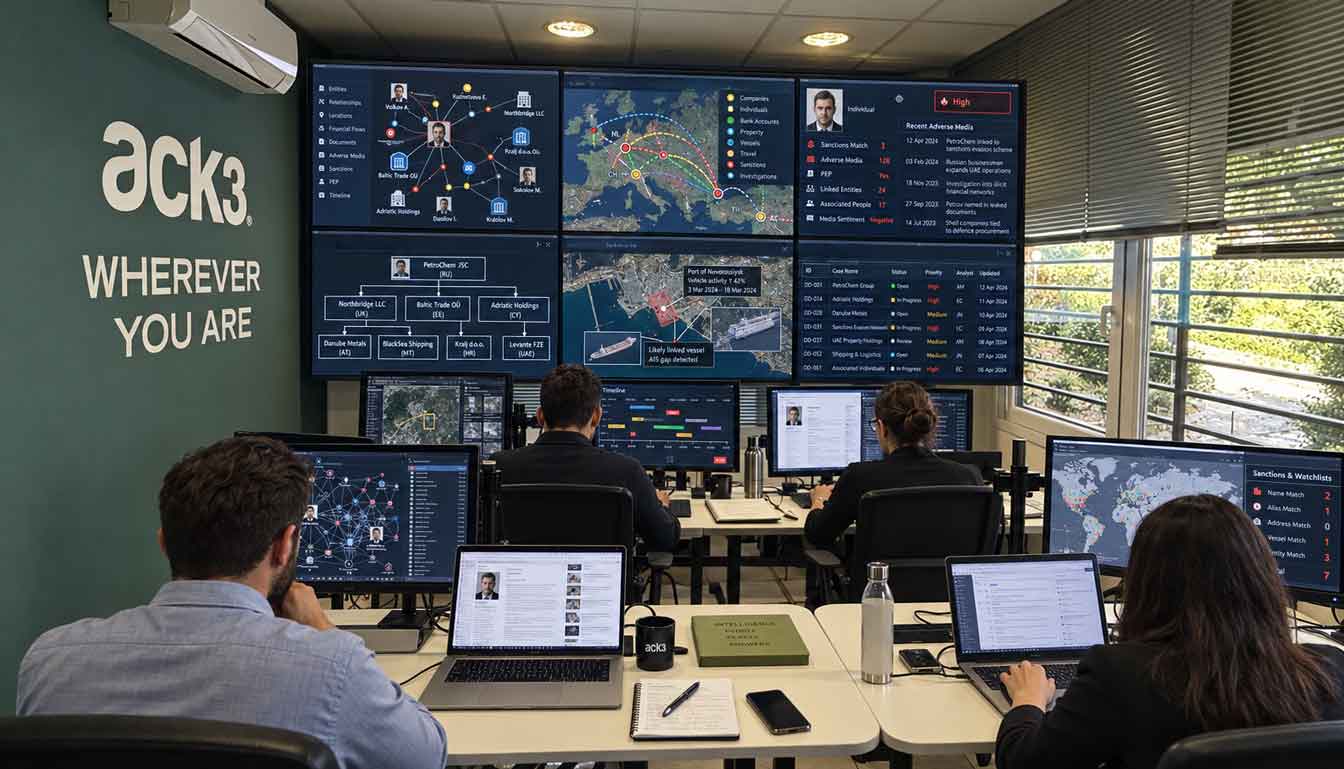
Madrid, Spain — ACK3, founded in 2010 by veterans of the Spanish Special Forces, provides strategic intelligence, economic intelligence, risk management and cybersecurity services to organisations operating in complex environments. As Toña Díaz, CCIO (Chief Corporate and International Officer) at ACK3, points out, this very activity is what allows the company to bring in and develop young intelligence analysts, who work from day one in its Security Operations Centre (SOC) in Madrid and in its consulting teams, with real clients, real information and real scenarios.
ACK3 is not a school: it is a consultancy. That is precisely why it offers young analysts what no classroom can: real clients, professional tools and the judgement that can only be built through operations.
2010
ACK3 founded
SOC
Operations centre in Madrid
5
Career levels
Day 1
Work on real cases
An intelligence consultancy committed to developing talent
ACK3’s model follows that of the major international risk consultancies, such as Control Risks: intelligence, analysis and operational support integrated into a single service. What sets ACK3 apart is its origin and its focus. It is a Spanish firm that, beyond advising its clients, invests in training the next generation of analysts. Interest in the profession keeps growing, and with it the range of master’s programmes in intelligence, cyber intelligence, geostrategy and economic intelligence. The obstacle comes afterwards: the market demands experience, and that experience can only be gained by working on real problems. That is the gap ACK3 fills through its own consulting activity.
“Universities are training excellent profiles. Our responsibility is to give them the environment where that knowledge becomes judgement: real clients, decisions with consequences and a team with operational experience supporting them from day one.”
— Jorge Quintana, CEO of ACK3
What an intelligence analyst does at ACK3
Analysts work across the same areas the company offers its clients, integrated into a common operational picture:
- Strategic and geopolitical intelligence: reading the environment, scenarios, trends and early warning.
- Economic and corporate intelligence: due diligence and analysis of actors, networks and interests.
- OSINT, GEOINT and virtual HUMINT: collection and verification of information from multiple sources.
- Cyber intelligence and Threat Intelligence: detection and contextualisation of digital threats.
- Risk analysis and international security: support for travel, deployments, evacuations and crisis management.
The intelligence analyst’s toolkit
Tools can be learned; judgement is built. Even so, mastering professional platforms is what separates an academic profile from an operational analyst. These are the main categories ACK3’s teams work with:
| Category | Purpose | Tools and reference frameworks |
|---|---|---|
| Link and network analysis | Visualise relationships between people, companies, assets and events. | Maltego, IBM i2 Analyst’s Notebook |
| Data integration and analysis | Cross-reference large volumes of information from heterogeneous sources. | Palantir |
| Digital intelligence and reputational risk | Monitor digital exposure, threats and narratives. | Constella Intelligence, BlueFusion |
| OSINT and GEOINT | Collect and verify open-source and geospatial information. | OSINT techniques and tools, geospatial analysis |
| Cyber intelligence | Classify attacker tactics and techniques and indicators of compromise. | MITRE ATT&CK |
| Automation | Process sources and automate repetitive tasks. | Python, Bash |
| Compliance frameworks | Align security with national and international standards. | ISO/IEC 27001, Spain’s National Security Framework (ENS) |
“In a junior analyst we look for curiosity, the ability to question information and a willingness to learn. Tools can be taught; what we build together is the judgement to know which signal matters and what to do with it.”
— Toña Díaz, CCIO (Chief Corporate and International Officer) at ACK3
A full career within the company
ACK3 sees entry-level positions as the first step in a specialised career in operations and intelligence. This is the indicative career path:
| Stage | Focus |
|---|---|
| 1 · SOC Operator | Monitoring, source management and early warning. |
| 2 · Intelligence Analyst | Producing analysis and risk assessments, and responding to requests for information. |
| 3 · Senior Analyst / SOC Team Leader | Specialisation and team coordination. |
| 4 · Intelligence Manager | Leading the intelligence function. |
| 5 · Head of Operations | Responsibility for operations. |
Progression subject to experience, performance, specialisation and the ability to take on increasing responsibility.
There are three ways to join: vacancies posted on the ACK3 careers portal, the ACK3 Talent Gateway programme (a talent pool for future projects, internships and training programmes) and ACK3 Academy, the company’s training division.
Frequently asked questions
What does ACK3 offer young intelligence analysts?
A real consulting environment: work with clients from day one, continuous training, mastery of professional tools and a career that can lead from SOC operator to head of operations.
What tools does an intelligence analyst use?
Link-analysis platforms such as Maltego or IBM i2 Analyst’s Notebook, data-integration environments such as Palantir, digital intelligence tools, OSINT and GEOINT techniques, frameworks such as MITRE ATT&CK and automation languages such as Python.
What should you study to become an intelligence analyst?
The usual route is a degree in International Relations, Criminology, Security Management, Political Science, Law or Engineering, complemented by a master’s degree or specialised training in intelligence, cyber intelligence, security or economic intelligence. Native or C1 Spanish and at least B2 English are required.
Do you need military experience to work as an intelligence analyst?
No. Military or police experience is valued, but specialised training, command of techniques such as OSINT and analytical judgement are the foundation of the profile.
Start your career in intelligence
Browse ACK3’s open vacancies or join the Talent Gateway for future opportunities.