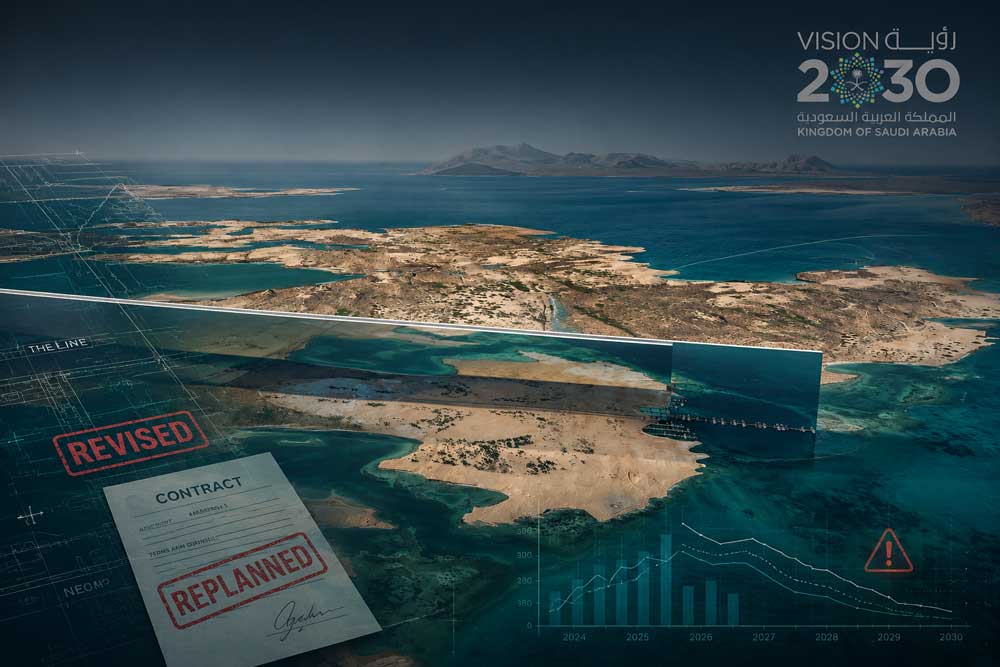
Saudi Arabia remains the great market of the decade for Spanish and European companies. But the NEOM reset has changed the rules of the game: the risk is no longer staying out — it is entering without understanding how your client decides
More than 200 Spanish companies operate in Saudi Arabia today, with over €70 billion won in contracts — from the Riyadh metro expansion to projects in renewables, defence, water and infrastructure. Vision 2030 continues to mobilise more than a trillion euros and the Kingdom still sees Spain as a preferred partner. None of that has changed. What has changed in 2026 is the nature of the risk: NEOM, the flagship of the gigaprojects, has entered a deep reset that includes $16 billion in payments earmarked to cancel contracts with its own contractors. For the company already there — or planning to enter —, understanding that reset is not optional: it is the difference between an extraordinary market and a miscalculated exposure.
What is the NEOM reset and why does it matter to the entire contracting chain?
NEOM is the largest of the Vision 2030 gigaprojects: a $500 billion development region in the north-west of the country, whose most iconic element — The Line, the 170-kilometre linear city — was at one point projected at over a trillion dollars. In 2026, the project has entered a replanning phase: The Line is postponed until after 2030, main tunnelling contracts and those for the Trojena ski resort were cancelled in March, and the population target for 2030 has dropped from 1.5 million inhabitants to 100,000. The 2026-2030 budget allocates more resources to terminating contracts than to building.
The backdrop is both fiscal and strategic. The profits of Aramco — the source funding Vision 2030 — have fallen for eleven consecutive quarters, and the Kingdom is reordering priorities towards projects with more immediate returns and towards the big fixed-date milestones: Riyadh’s Expo 2030 and the 2034 FIFA World Cup. This is not the collapse of Vision 2030 — it is its recalibration. But for the foreign contractor and investor, a recalibration on this scale has very concrete consequences: multi-year contracts that are renegotiated or terminated, payment chains that stretch out, and subcontractors absorbing the financial strain of the links above them.
contracts between 2026 and 2030
— versus the 1.5M once projected
companies in Saudi Arabia
A market that remains strategic for Spain
It is worth saying clearly: Saudi Arabia remains one of the greatest internationalisation opportunities of this decade for Spanish companies. Renfe, Talgo, Navantia, FCC, Acciona, Técnicas Reunidas and Alsa already operate in the country; the Riyadh metro expansion exceeds €10 billion; and the infrastructure, energy, water, tourism and defence sectors continue to demand exactly the kind of technological capability Spain exports. The Saudi Ministry of Investment itself has pointed to Spain as a gateway to Europe and Latin America. The NEOM reset does not close that market — it professionalises it. It separates the companies that enter with counterparty intelligence, replanning scenarios and a robust contractual structure from those that enter with nothing but the contract figure in mind.
“Spain is a natural gateway to Europe and Latin America. Saudi Arabia remains committed to investing in Spanish companies that demonstrate experience, knowledge and technological capability.”
— Saudi Ministry of Investment, at the business forum of the Spanish Chamber of Commerce
The reset signals every contractor must read
The reset is not market gossip: it is a sequence of documented decisions throughout 2025 and 2026. Each one contains information about how the Saudi client decides and where spending is moving:
| Signal | Date | What it means for the foreign contractor |
|---|---|---|
| The Line postponed until after 2030 | May 2026 | Contracts tied to the project’s most ambitious element are on indefinite hold. The associated order book ceases to be a predictable asset. |
| Cancellation of tunnelling and Trojena contracts | March 2026 | Multi-billion contracts in execution can be terminated. The question becomes the quality of the termination clauses and the real ability to collect compensation. |
| $16B budgeted to terminate agreements | June 2026 | The client assumes that cancelling is cheaper than continuing. It is a rational portfolio decision — and a warning about the firmness of any multi-year commitment. |
| Eleven consecutive quarters of falling Aramco profits | 2023-2026 | Vision 2030’s funding source is under sustained pressure. Spending is being reordered towards projects with visible returns and fixed-date milestones (Expo 2030, 2034 World Cup). |
| New real-estate ownership law for foreigners | January 2026 | Opening by designated zones (NEOM, AMAALA, Red Sea, AlUla). A positive signal of regulatory opening — which at the same time demands understanding a new framework with no case law yet. |
“NEOM’s budget for 2026-2030 includes $16 billion in payments earmarked for contractors to terminate long-term agreements. Saudi authorities expect to spend more money cancelling projects at NEOM than building them over the next five years.”
The five risk vectors for the foreign contractor in Saudi Arabia
Winning the contract is the beginning, not the end. These are the risk vectors that a competitive technical and commercial bid does not cover on its own:
| Risk vector | Manageable from the bid | Why it matters in the current context |
|---|---|---|
| Programme replanning and cancellation | Partial | Gigaprojects are replanned by sovereign decision, not market logic. Without robust termination clauses and replanning scenarios, a multi-year contract is a still photo of a client that keeps moving. |
| Cascading payment chains | No | The financial strain on main contractors flows downwards. A Spanish subcontractor can hold a flawless contract with a counterparty that, in turn, is not getting paid. |
| Concentration on a single state client | Partial | PIF and its vehicles concentrate demand. A Saudi portfolio with no diversification across programmes, ministries and private operators is a single exposure disguised as several contracts. |
| Jurisdiction, arbitration and enforcement of guarantees | Partial | Agreeing international arbitration is only half the problem; the other half is real enforceability against a sovereign or quasi-sovereign counterparty, and the commercial cost of triggering it. |
| Local partners, agents and subcontractors | No | Market entry usually requires a local partner. Their real solvency, ties to the administration and track record do not appear in the documentation they themselves provide: they require independent verification on the ground. |
The most common mistake when entering the Saudi market
Confusing the size of the client with the security of the contract. The fact that your counterparty is a sovereign fund with $900 billion in assets does not mean your $40 million contract is a priority for it — it means your negotiating power in a replanning is minimal. Protection does not come from the prestige of the project: it comes from prior intelligence on how the client decides, from the contractual structure and from continuous monitoring of the reset signals.
Is your company going to compete in Saudi Arabia with the same information as its competitors?
ACK3® supports Spanish and European companies entering and operating in the Middle East with strategic intelligence, counterparty due diligence and jurisdictional risk assessment. Not to hold back the decision to enter — so that it is taken with an information advantage over the rest of the market.
| ACK3® service | What it includes |
|---|---|
| Due diligence on counterparties and local partners | Verification of solvency, beneficial ownership, ties to the administration, litigation history and reputation of partners, agents and subcontractors in the jurisdiction. |
| Strategic Intelligence on programmes and clients | Analysis of the real health of programmes (political priority, funding, replanning signals) before committing resources to a bid. |
| Jurisdictional risk assessment | Applicable regulatory framework, enforceability of guarantees and arbitration, exposure of the chosen contractual structure and regulatory changes under way. |
| Continuous monitoring | Tracking of reset signals across programmes and counterparties throughout contract execution: early warnings before the replanning arrives by letter. |
Saudi Arabia will remain one of the great markets of the decade. The difference between the companies that capture that opportunity and those that absorb its volatility will not lie in the size of their contracts — it will lie in the quality of their information. ACK3® is where those decisions are signed. Wherever You Are.