Why the EU–India agreement is redefining value chains, economic power, and strategic risks for Spanish companies
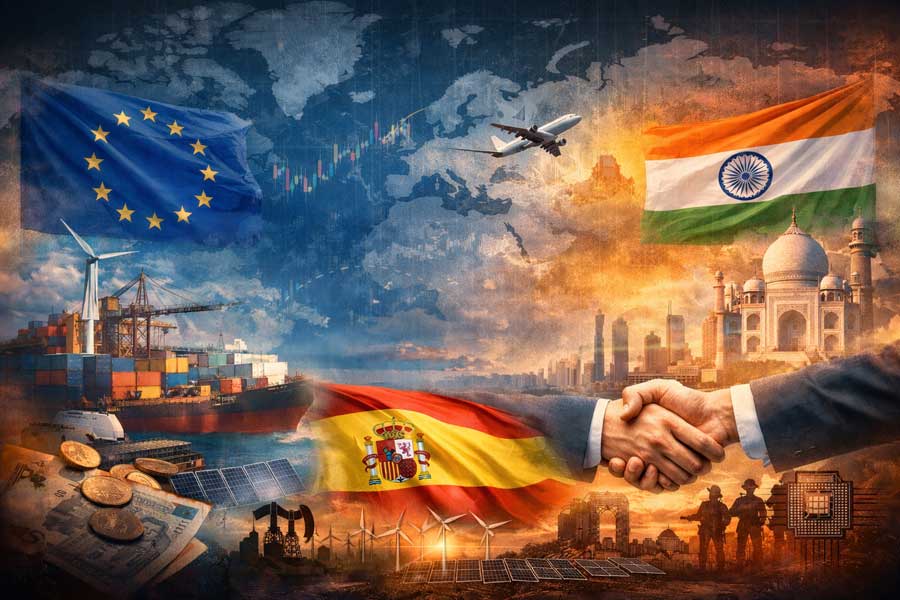
The Free Trade Agreement between the European Union and India, signed on January 27, 2026, has been described by political leaders and international analysts as the “Mother of All Deals.” This is not hyperbole. We are facing one of the greatest trade milestones of the 21st century due to its economic scope, its geopolitical dimension, and its transformative potential over global value chains. The agreement opens preferential access to a market of nearly 2 billion consumers, covers approximately 25% of global GDP, and eliminates or reduces tariffs on virtually all exchanges of goods and services between the EU and India. Its ambition goes far beyond traditional trade: it includes chapters on sustainability, services, technology, investment, regulatory cooperation, and strategic dialogue. Although the treaty still must be formally ratified by the European Parliament and the Indian Parliament, projections are already compelling: doubling European exports to India before 2032 and generating savings of up to 4 billion euros per year in tariffs for EU companies. For Spain, the potential impact is profound and multifaceted.
What is the “Mother of All Deals”?
The expression “Mother of All Deals” is used to describe trade agreements of systemic scale, capable of structurally altering global flows of trade, investment, and economic power. In the case of the free trade agreement between the European Union and India, the term reflects its unprecedented dimension, both in terms of the volume of population and GDP it covers and its long-term strategic impact. It is not merely a tariff reduction, but a comprehensive framework that redefines market access rules, regulatory standards, technological cooperation, sustainability, and geopolitical influence. This type of agreement acts as a catalyst for new value chains, redistributes competitive advantages among countries and companies, and shapes investment decisions for decades. Therefore, the “Mother of All Deals” is not just a trade treaty, but a clear signal of how the international economic order is being reconfigured in a context of geopolitical fragmentation and strategic competition among major blocs.
According to Ursula von der Leyen, President of the European Commission:
“The EU and India made history today by deepening their partnership, which is between two of the world’s largest democracies. We have created a free trade area of 2 billion people, from which both sides will benefit economically… This agreement sends a powerful message to the world: that we choose fair trade over tariffs, partnerships over isolation, and sustainability over overexploitation.”
Narendra Modi, Prime Minister of India, stated after the conclusion of the EU–India agreement:
“This agreement marks a new era in the relationship between India and Europe. It is not just about trade, but about strategic trust, shared growth, and long-term stability.”
Direct and indirect impact on Spain
Concrete economic opportunities
Greater market access for Spanish exporters
Spain starts from a strong competitive position in several of the sectors most benefited by the agreement.
- Agri-food: Flagship products such as wine and olive oil will experience significant tariff reductions. In the case of wine, tariffs—historically around 150%—will be gradually reduced to 75% or even lower in the long term. Olive oil, meanwhile, is moving toward an almost zero tariff, a strategic advantage for a country that is a world leader in production and export. This not only improves margins but also allows Spanish products to be repositioned in premium segments of India’s rapidly growing urban market.
- Machinery, chemicals, and industrial goods: Spanish industrial clusters—particularly in automotive components, capital goods, and advanced chemicals—can capture a significant share of the projected increase in European exports. The reduction of barriers and regulatory harmonization favor the entry of specialized suppliers with medium-to-high technological capacity, a segment where Spain is highly competitive.
- Professional services and digital technologies: The agreement promotes the liberalization of services, facilitating the entry of European companies into India in consulting, engineering, architecture, financial services, legal-tech, and digital solutions. Spain, with a growing ecosystem in these areas, has room to expand its presence, especially if it combines technical offerings with local partners.
New investment opportunities in India
Beyond trade, the agreement encourages partial relocation of value chains and direct investment.
Spanish companies—from large groups to SMEs with an international focus—can integrate into priority sectors for India and the EU:
- Renewable energy and energy transition
- Transport and urban infrastructure
- Green technologies and circular economy
The convergence of trade liberalization and cooperation in sustainability makes India a strategic destination for productive investment with a long-term horizon.
Specific risks and challenges for Spain
Intensification of competition in sensitive sectors
The opening is bidirectional. The smoother entry of Indian products into the EU may put pressure on vulnerable sectors, such as textiles, certain manufacturing, and electronic components. Some Spanish SMEs, with smaller scale or limited differentiation capacity, could be particularly exposed.
Non-tariff barriers and adaptation costs
The elimination of tariffs does not equate to automatic access. Technical, regulatory, and certification barriers remain, requiring investment in adaptation.
Additionally, European instruments such as the Carbon Border Adjustment Mechanism (CBAM) add regulatory complexity and extra costs for exporters who do not integrate carbon footprint and traceability criteria from the origin.
Integrated structural competition
In sectors such as automotive, where Spain is a key player in vehicle and component exports, competition from Indian manufacturers like Tata or Mahindra—strong in costs, local production, and market adaptation—forces a rethink of strategies. It is not just about competing on price, but also on segmentation, technological specialization, and added value.
Geopolitics and influence economy
This agreement is signed in a context of rapidly reconfigured trade alliances, marked by tensions with the United States, partial decouplings from China, and a global race to secure resilient supply chains. For the EU—and for Spain in particular—India is consolidating as an alternative strategic partner, both economically and politically. The agreement includes structured dialogues on defense, security, space, critical technology, and cybersecurity, opening opportunities in dual-use sectors where Spain has relevant industrial capabilities and innovation. Spain also combines its status as an exporting power with an internationalized business network and experience in emerging markets, strengthening its position as a bridge actor within this new trade architecture.
The role of economic intelligence in this scenario
To turn this geoeconomic shift into a real advantage, it is not enough to react. Applied economic intelligence is needed. This is where the economic intelligence consultant positions themselves as a strategic partner.
Market intelligence and advanced sectoral analysis
- Mapping of global value chains (automotive, agri-food, intermediate goods) to identify real competitive advantages and bottlenecks.
- Assessment of regulatory barriers (CBAM, rules of origin, certifications) and design of adaptation pathways for exporting SMEs.
- Dynamic demand forecasts in India, analyzing price elasticity and consumer cultural sensitivity.
Corporate risk and resilience strategies
- Modeling of geoeconomic scenarios in response to tariff changes, third-country trade tensions, or macroeconomic shocks.
- Commercial, operational, and reputational risk mitigation plans, crucial in emerging markets with high regulatory volatility.
Institutional relations and strategic access
- Support for public-private dialogue between companies, chambers of commerce, and European and Indian institutions.
- Identification of local partners for joint ventures, industrial licensing, and distribution networks, reducing cultural friction and entry risk.
The EU–India agreement is redefining the global economic landscape and accelerating the transition toward a more multipolar trade system. For Spain, it represents a historic opportunity for expansion, but also a test of competitiveness, adaptation, and strategic vision. ACK3’s role as a provider of strategic economic intelligence is key to turning this moment into a sustainable advantage: anticipating risks, prioritizing opportunities, and positioning Spanish companies as relevant players in the new global balances. According to Jorge Quintana, ACK3 CEO:
“In this new cycle, applied intelligence will make the difference between those who react and those who lead.”
Is your company prepared to compete and grow in the new EU–India axis?
At ACK3, we help companies and organizations anticipate risks, identify real opportunities, and design entry and positioning strategies in complex markets like India, combining economic intelligence, geopolitical analysis, and strategic support.