
Global Risk Map 2026
What are the top global risks for 2026 according to ACK3 experts?
In an increasingly complex and interconnected world, understanding global risk dynamics has become essential for informed decision-making. The Global Risk Map 2026 provides a comprehensive overview of the security, health, and operational challenges shaping the year ahead. Designed for businesses, policymakers, and international travelers, the map offers a clear, intelligence-driven perspective on where risks are intensifying—and where stability endures.
Safety and travel insights
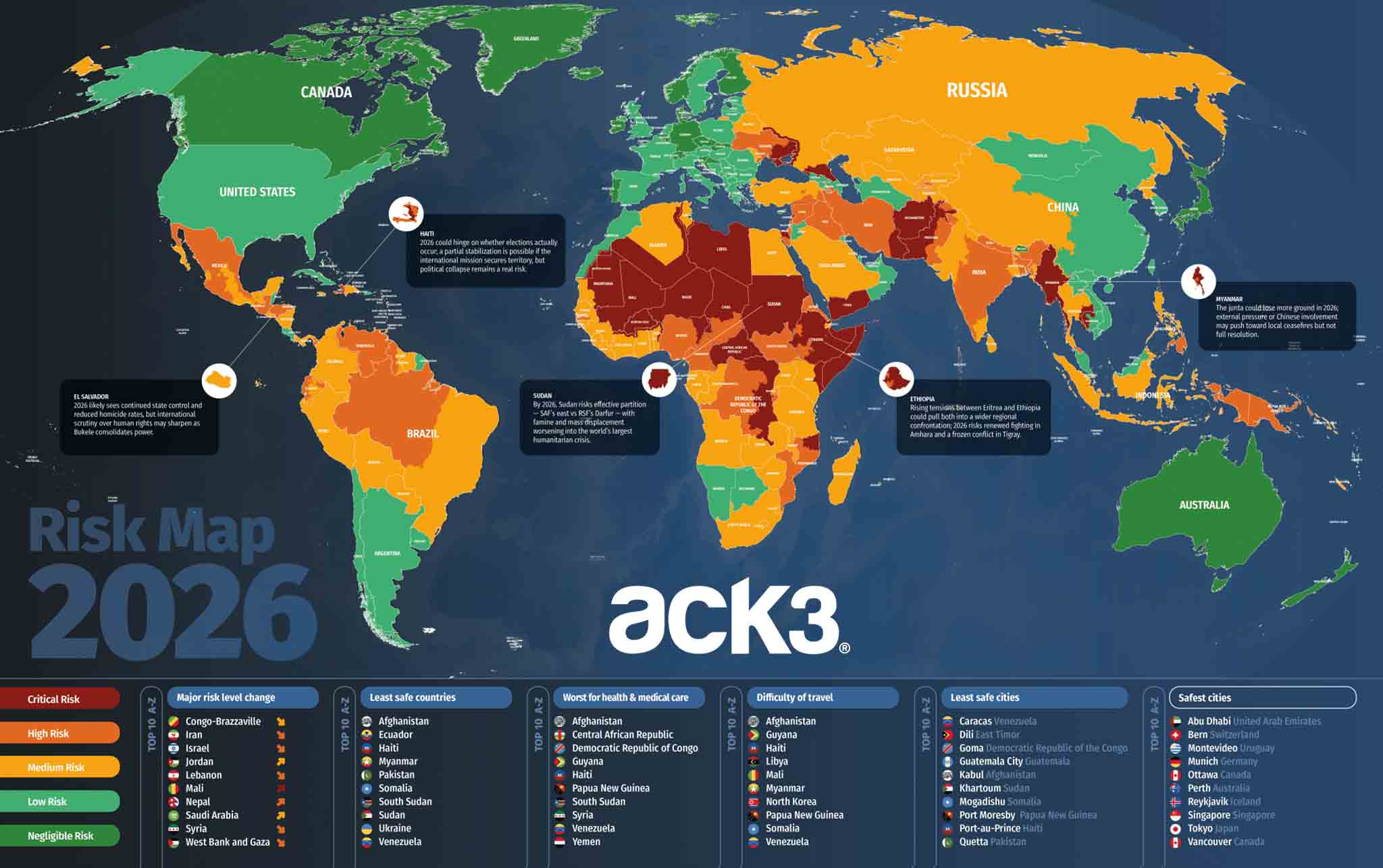
What are the 10 least safe countries in the world?
Security assessments for 2026 highlight how armed conflict, political instability, and widespread crime continue to shape risk levels in several regions. These countries face overlapping challenges that significantly impact safety for residents, travelers, and organizations operating on the ground.
Least safe countries
01. Afghanistan
02. Ecuador
03. Haiti
04. Myanmar
05. Pakistan
06. Somalia
07. South Sudan
08. Sudan
09. Ukraine
10. Venezuela
What are the 10 worst countries to travel to?
Travel difficulty in 2026 is driven not only by security concerns but also by infrastructure limitations, border restrictions, health risks, and weak emergency response capabilities. In these destinations, mobility can be unpredictable, and support options are often limited.
Difficultly of travel
01. Afghanistan
02. Guyana
03. Haiti
04. Libya
05. Mali
06. Myanmar
07. North Korea
08. Papua New Guinea
09. Somalia
10. Venezuela
What are the 10 least safe cities in the world?
Urban risk remains a defining factor in global safety assessments. High crime rates, militant activity, political unrest, and limited state control contribute to severe challenges in these cities, many of which are classified as high-risk or no-go areas in 2026.
Least safe cities
01. Caracas
02. Dili
03. Goma
04. Guatemala city
05. Kabul
06. Khartoum
07. Mogadishu
08. Port Moresby
09. Port-au-Prince
10. Quetta
Which are the 10 worst countries for healthcare?
Healthcare fragility continues to amplify risk worldwide. In 2026, limited access to medical care, shortages of supplies, disease outbreaks, and weak emergency response systems remain critical concerns—often requiring medical evacuation for serious cases.
Worst for health and medical care
01. Afghanistan
02. Central African Republic
03. Democratic Republic of Congo
04. Guyana
05. Haiti
06. Papua New Guinea
07. South Sudan
08. Syria
09. Venezuela
10. Yemen
Fragility as a core driver of global risk
The 2026 rankings reveal a clear concentration of risk in fragile and conflict-affected states where political instability, weak institutions, and limited state control reinforce one another. Countries such as Afghanistan, Haiti, Sudan, South Sudan, Myanmar, and Somalia consistently appear across security, travel, and healthcare risk categories, highlighting how fragility is rarely confined to a single dimension. Governance gaps, armed groups, and economic pressure erode public services, restrict mobility, and undermine civilian safety.
Interconnected instability in the 2026 global landscape
These patterns reflect a broader shift from short-term crises to prolonged, systemic instability. Regional conflicts, transnational crime, and external interference increasingly spill across borders, while climate stress and economic strain act as accelerants. Risk in 2026 is therefore interconnected, demanding continuous monitoring, local intelligence, and adaptive risk management rather than static assessments.
Understanding global risk in 2026: a strategic outlook
Persistent conflicts, shifting alliances, and uneven recovery from past crises continue to shape global risk. Armed conflicts and insurgencies remain primary drivers of critical risk, particularly in Africa, the Middle East, Eastern Europe, and South Asia. Countries like Afghanistan, Myanmar, Pakistan, Sudan, Haiti, and Somalia remain highly unstable due to militant activity, civil unrest, and limited state control.
Healthcare vulnerabilities add another critical layer. Fragile systems in Papua New Guinea, South Sudan, Yemen, Syria, Haiti, and Venezuela expose local populations and travelers to elevated risk, particularly where medical evacuation may be necessary.
Urban environments further highlight global disparities. Cities such as Abu Dhabi, Bern, Singapore, Tokyo, and Vancouver rank among the safest, with low crime and strong governance. In contrast, Kabul, Port-au-Prince, Caracas, and Khartoum are deeply affected by unrest, organized crime, and infrastructure breakdown.
Technology and cyber risk
In 2026, technology continues to be a double-edged sword. Advances in AI, digital infrastructure, and connectivity create opportunities for growth but also expose organizations to unprecedented cyber threats. Critical sectors such as healthcare, logistics, and finance face targeted attacks from both criminal networks and state-sponsored actors. Diverging regulations across regions—particularly between the U.S., EU, and China—make cybersecurity and data governance essential for all global operations.
Economic volatility and debt pressures
Global economic risk remains high in 2026, driven by uneven growth, rising debt levels, and inflationary pressures. Emerging economies in Latin America, sub-Saharan Africa, and parts of Asia are particularly vulnerable, while advanced economies face slowdowns and energy price fluctuations. Social unrest linked to unemployment, austerity measures, and cost-of-living increases is expected to continue, emphasizing the need for careful monitoring and operational planning.
Healthcare fragility
Healthcare systems in several high-risk countries remain under severe strain in 2026. Afghanistan, Haiti, Papua New Guinea, Yemen, and South Sudan face chronic shortages of medical supplies, limited emergency services, and recurring outbreaks of preventable diseases. Organizations and travelers operating in these regions must account for elevated medical risks, including the potential need for emergency evacuation and specialized medical support.
Travel, mobility and operational challenges
While international travel has largely resumed, mobility risks persist in 2026. Political instability, poor infrastructure, and healthcare gaps make certain countries particularly challenging for business operations. Regions such as Haiti, Libya, and Papua New Guinea illustrate how overlapping security, health, and logistical risks can disrupt travel and operational continuity, emphasizing the need for robust risk management and contingency planning.
Why risk mapping still matters
Threats describe the external environment, but risk is personal. Exposure, location, and organizational support determine the actual risk faced. A country with high threat levels may pose limited risk if personnel or assets are absent, while moderate-threat environments can become high risk without proper preparation.
The Global Risk Map 2026 remains an essential reference. It identifies emerging patterns, contextualizes global developments, and prepares travelers before risk becomes reality. In a world defined by uncertainty, clarity and preparedness are the most effective tools for protecting people and operations.
Contact us
Are you interested in ACK3’s Travel Risk Management Services?
Reach out to us by filling out the following form: