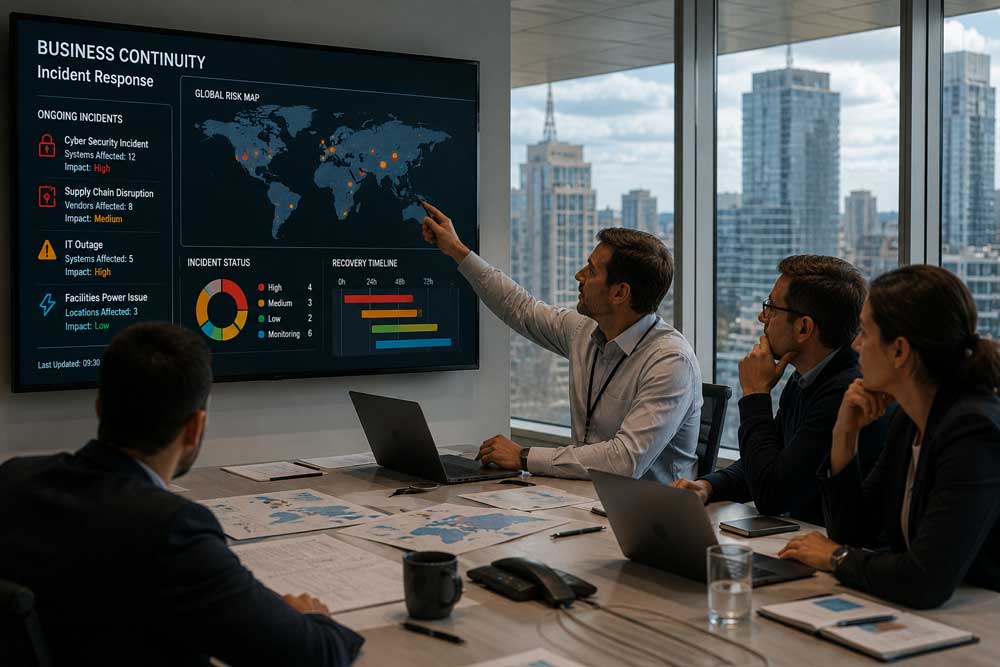
How international companies are redefining their contingency plans to respond to cyberattacks, geopolitical crises, operational disruptions, and increasingly complex and unpredictable environments.
For years, many organizations viewed contingency plans as documents associated primarily with compliance, audits, or business continuity requirements. The operating environment of 2026 is proving otherwise. True corporate resilience no longer depends on having protocols stored in a file cabinet — it depends on the real ability to respond when a crisis simultaneously affects people, operations, suppliers, technology, and decision-making capacity.
Cyberattacks, geopolitical crises, supply chain disruptions, critical infrastructure failures, disinformation campaigns, social unrest, and reputational incidents are forcing organizations to rethink how they protect their operations. The question is no longer whether an organization will face a crisis. It is whether it will be prepared to keep operating when it happens.
The new operating environment demands a new approach to resilience
Organizations no longer operate exclusively in stable, predictable markets. They operate in complex environments where physical, digital, reputational, and geopolitical risks converge simultaneously. The speed of today’s crises demands more agile, integrated, and pressure-tested decision-making structures than the compliance-driven plans of the past decade.
According to the World Economic Forum’s Global Risks Report, geopolitical fragmentation, disinformation, supply chain disruption, and extreme weather remain among the most significant threats facing organizations. At the same time, institutions such as ISO, ENISA, and the U.S. CISA increasingly emphasize the need for integrated resilience frameworks that combine business continuity, crisis management, cybersecurity, and operational response into a single capability — not four separate silos.
disinformation (WEF Global Risks Report)
of a data breach (IBM)
a major incident (EU NIS2 / GDPR)
What is a contingency plan?
A contingency plan is a structured set of protocols, capabilities, and decision-making frameworks designed to keep an organization performing its critical functions when a crisis disrupts normal operations. In today’s environment it can no longer be a technical document or a compliance artifact: it must be a real operational capability focused on protecting people, assets, information, and business continuity under pressure.
A modern contingency plan must address scenarios such as cyberattacks, supply chain disruption, critical supplier failure, geopolitical crises, reputational incidents, and the degradation of essential infrastructure. Beyond procedures, it requires clear decision-making structures, crisis communication protocols, real-time monitoring, and rapid response capabilities. In practice, it should allow an organization to:
- Reduce the operational impact of critical incidents.
- Make rapid decisions under pressure, with clear ownership.
- Protect people, assets, and operations.
- Maintain operational continuity of critical functions.
- Coordinate internal and external communications.
- Activate response and escalation protocols without hesitation.
- Restore operational capability as quickly as possible.
Signs your organization needs a contingency plan
Many organizations do not recognize their vulnerabilities until a crisis exposes structural weaknesses that were never assessed. Common warning signs include:
- Critical dependence on a single supplier or infrastructure provider.
- Lack of clearly defined escalation procedures.
- Teams unsure how to respond during a crisis.
- Poor coordination between departments.
- Absence of simulations or testing exercises.
- Excessive dependence on key individuals.
- No real-time monitoring capability.
- Absence of crisis communication protocols.
- International operations in complex environments.
- Digital infrastructure without redundancy.
“The real risk is not failing to have a plan. It is discovering, in the middle of a crisis, that nobody truly knows how to execute it.”
— ACK3® SOC Team Analysis
Key risks organizations should consider in 2026
The threat landscape is no longer a list of isolated events. In 2026 the defining feature is convergence: a single incident often cascades across the physical, digital, and reputational domains at the same time.
| Risk | Potential impact | Typical examples | 2026 trend |
|---|---|---|---|
| Cyberattacks | Operational disruption | Ransomware, data breaches, extortion | Rising |
| Geopolitical events | International disruption | Sanctions, conflict, trade restrictions | High |
| Supply chain disruption | Delays or operational shutdowns | Route closures, strikes, border restrictions | Elevated |
| Supplier & infrastructure failure | Critical service interruption | Cloud, energy, telecom outages | Elevated |
| Reputational & disinformation | Financial and media impact | Leaks, public incidents, coordinated misinformation | Rising |
Source: ACK3® RiskPulse operational analysis on corporate resilience and business continuity.
Contingency planning, business continuity, and crisis management: key differences
These three disciplines are often used interchangeably, but they answer different questions. A resilient organization runs all three as a single, coordinated capability.
| Concept | Primary objective | Operational focus |
|---|---|---|
| Contingency planning | Respond to incidents | Immediate action |
| Business continuity | Maintain critical functions | Sustained operations |
| Crisis management | Coordinate strategic decisions | Leadership and communication |
What a modern contingency plan must include in 2026
A plan that only exists on paper is a liability disguised as reassurance. Five components separate a document from an operational capability.
A clear decision-making and governance structure
Under pressure, ambiguity is the enemy. A resilient plan defines in advance who decides, who executes, and who communicates — with named roles, deputies, and thresholds that trigger escalation automatically rather than through debate.
Real-time monitoring and early warning
The organizations that absorb crises best are those that see them first. Continuous monitoring across physical, cyber, and geopolitical domains buys the single most valuable resource in any incident: time to decide before the situation dictates the decision.
Crisis communication protocols
In a crisis, silence and improvisation are equally damaging. Communication must be planned as carefully as the operational response, on two distinct fronts.
Internal communication
Employees need to know what is happening, what is expected of them, and where to get instructions — through channels that remain available even if primary systems are compromised.
External and stakeholder communication
Clients, regulators, partners, and media form their judgment in the first hours. A pre-approved framework for what is said, by whom, and how fast protects both operations and reputation.
Response, escalation, and continuity procedures
The plan must translate into concrete actions: how to contain the incident, how to keep critical functions running on alternative resources, and how to escalate when the situation exceeds the first response tier.
Testing, simulation, and continuous improvement
A plan that has never been tested is an assumption. Regular exercises turn protocols into muscle memory and reveal the gaps no document can predict.
Tabletop exercises
Discussion-based scenarios that test decision-making, roles, and communication flows without disrupting operations — ideal for validating governance and escalation logic.
Full-scale simulations
Live exercises that stress-test the response under realistic conditions, exposing coordination failures, single points of dependence, and recovery times before a real crisis does.
“Geopolitical fragmentation, disinformation, and supply chain disruption rank among the most severe risks organizations will face, and increasingly interact with one another, compounding their impact.”
“Business continuity management is defined internationally as the capability of an organization to continue delivering products and services within acceptable timeframes at predefined capacity during a disruption.”
The most common mistake in corporate resilience
Treating the contingency plan as a document to be filed rather than a capability to be executed. In most crises, the failure is not technical — it is organizational: teams that never rehearsed, escalation paths nobody owned, and communication that started too late. The difference between a resilient organization and a vulnerable one is rarely the existence of the plan. It is the ability to run it when everything is moving at once.
Is your organization ready to keep operating when the next crisis hits?
ACK3® helps organizations build resilience that works under pressure — combining contingency planning, crisis management, real-time monitoring, and business continuity into a single, tested capability aligned with international standards.
| ACK3® Service | What it includes |
|---|---|
| Contingency & Resilience Planning | Design and stress-testing of contingency plans, decision-making structures, and escalation protocols aligned with ISO 22301 and NIS2. |
| Crisis Management | Crisis response support, decision advisory under pressure, and coordination of physical, digital, and reputational response. |
| Security Operations Center (SOC) | Real-time monitoring, early warning, and threat intelligence across physical, cyber, and geopolitical domains. |
| Business Continuity & Recovery | Continuity planning for critical functions, supplier and infrastructure redundancy, and structured post-incident recovery. |
Resilience is not the plan you have. It is what your organization can actually do when people, operations, technology, and reputation are under pressure at the same time. ACK3® builds that capability — and tests it before the crisis does. Wherever You Are.